Google Pics Turns Image Design Into a Prompt-First AI Workflow
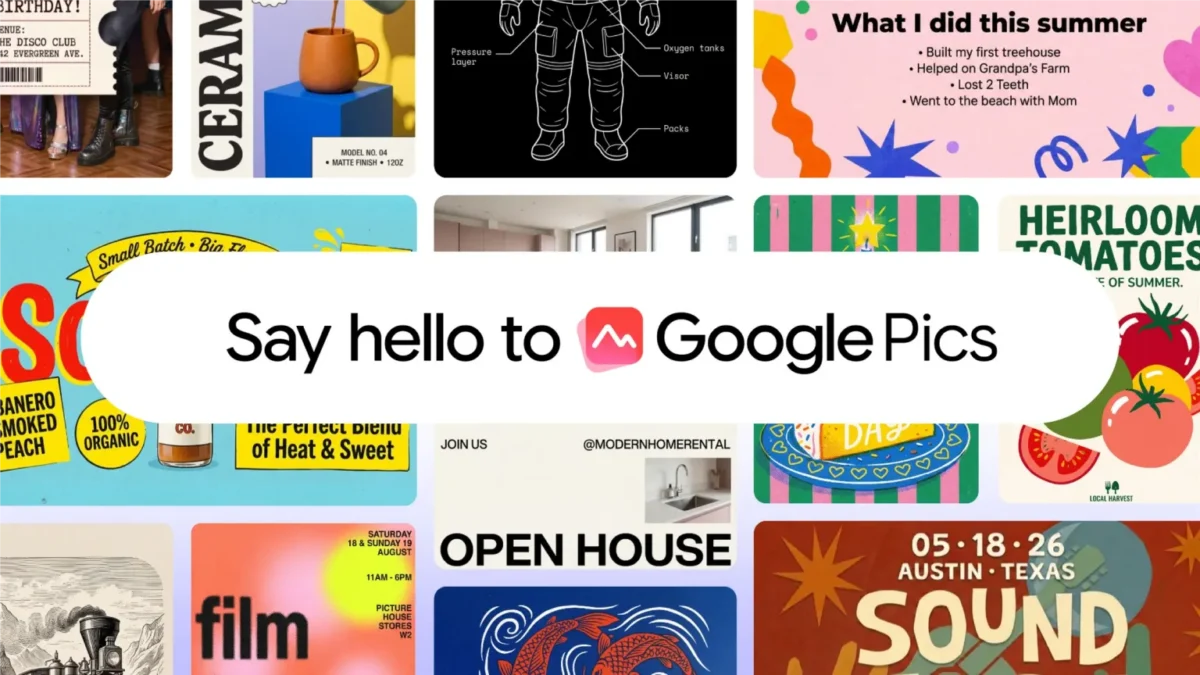
Google is taking aim at the traditional design workflow with a new AI-powered tool that puts prompts ahead of menus, templates and manual editing.
The company has introduced Google Pics, a new image creation and editing experience designed to let users build professional-looking visuals by simply describing what they want.
Instead of starting with a blank canvas and searching through design elements, users can tell the system what they need and refine the result through natural-language instructions.
That may sound like another AI image generator, but Google’s positioning is more ambitious. The goal is not simply to create an image from text. Google wants Pics to become a practical design workspace where people can generate, modify and collaborate on visuals without needing traditional design expertise.
Key Takeaways
- Google has introduced Google Pics, an AI-powered image creation and editing tool.
- Users can generate and modify visuals using natural-language prompts.
- The tool supports tasks such as object editing, text changes, translation and image upscaling.
- Google is positioning Pics as part of its Workspace ecosystem and a competitor to established design platforms.
- The bigger shift is from manually designing graphics to describing the desired result and letting AI handle much of the execution.
Google Wants You to Describe the Design Instead of Building It
Traditional design software asks users to think in terms of tools.
You select a canvas, choose a template, add text, move objects, adjust fonts, crop images and repeat the process until everything looks right.
Google Pics approaches the problem differently.
The basic idea is simple: explain what you want in a prompt and let AI create the starting point.
Google says Pics can generate custom graphics and then refine them through additional instructions. Users can also interact more directly with individual elements of an image, making it possible to ask for specific changes rather than recreating the entire visual.
That makes the experience closer to having an AI design assistant than operating conventional graphic-design software.
Google’s new tool is powered by its Gemini technology and its latest image-generation capabilities, including the Nano Banana model family.
The important distinction is that image generation is only part of the product.
Pics is designed around editing as well.
More Than Text-to-Image Generation
AI image generators have become increasingly capable at producing impressive pictures from prompts.
The problem starts once you need to make precise changes.
Perhaps the headline needs to move. Maybe one object should disappear. The colors need to change. A product needs to remain identical while the background is replaced.
This is where Google Pics is trying to differentiate itself.
According to Google, users can isolate objects, modify text inside images, translate words and upscale visuals. The company also highlights automatic cropping for different formats and more precise editing capabilities.
Those features target a very practical problem.
A generated image that looks good is not necessarily useful for a real marketing campaign, presentation or social post. Businesses typically need multiple versions of the same asset, different dimensions and frequent revisions.
An AI editor that can handle those modifications through conversation could remove a significant amount of repetitive work.
For smaller businesses and creators, that could be even more important because they often need professional-looking graphics without having a dedicated designer on staff.
Google Pics Is Built for the Workspace Ecosystem
Google is also betting on integration.
The company says Google Pics is being connected with Google Workspace, with image creation and editing capabilities available through experiences involving apps such as Docs and Slides. Additional Workspace integrations are planned, including Drive support.
This could become one of Google’s biggest advantages.
A standalone AI design tool has to persuade users to move their workflow into another application.
Google doesn’t necessarily have that problem.
Millions of people already work inside Google Docs, Slides and Drive. Bringing AI-powered image creation into that ecosystem means users can potentially generate a visual without opening separate design software.
Imagine creating a presentation and realizing you need a custom illustration.
Instead of leaving the document, searching for an image or opening a design application, you could potentially generate the visual directly within the Google ecosystem.
That is a subtle change in workflow, but it could become a major one over time.
The Canva Comparison Is About Workflow, Not Just Features
Canva has built its reputation around making design accessible to people who are not professional graphic designers.
Google is approaching the same audience from a different direction.
Canva’s traditional model is based heavily on templates, drag-and-drop editing and visual controls. Google’s approach puts conversational AI at the center.
Neither method is automatically better.
Templates can provide predictable results and precise control. AI prompting can dramatically reduce the number of steps required to reach a useful first draft.
The real competition could therefore come down to speed and flexibility.
For a user who already knows exactly how to manipulate a design, traditional tools may remain more efficient.
For someone who simply wants to say, “Create a professional event flyer with this text, this product image and these dimensions,” the prompt-based model can be far more approachable.
Google’s strategy also benefits from the broader momentum behind Gemini.
The company is increasingly embedding AI into products rather than treating AI as a separate destination. Search, Workspace and other Google services are becoming increasingly conversational and task-oriented.
Pics fits neatly into that strategy.
The Bigger Change: AI Is Becoming the Interface
The most interesting part of Google Pics is not the image generator itself.
It is the interface.
For decades, software has required users to learn the application. You learn where the buttons are, what the menus do and which tools produce the desired result.
Generative AI reverses that relationship.
Instead of learning the tool, users increasingly describe the outcome.
That shift is happening across software, from writing assistants and coding agents to AI-powered search and now visual design.
Google’s latest move suggests that design software could follow the same path.
The AI becomes the layer between the user and the complicated underlying functionality.
For everyday users, that’s potentially a huge usability improvement.
For professional designers, however, the story is more complicated. AI can accelerate repetitive production tasks, but creative control, consistency and brand management still matter. Whether prompt-driven editing can reliably handle those requirements at scale will be an important test for Google.
What Is Confirmed and What Remains to Be Seen?
Confirmed: Google has launched Google Pics as an AI-powered image creation and editing tool. The company says it supports prompt-based creation, object-level editing, text manipulation, translation, image enhancement and other visual workflows.
Confirmed: Google is integrating Pics with its broader Workspace ecosystem, including Docs and Slides, with additional integrations planned.
Confirmed: Google is positioning the experience around Gemini and its latest image-generation technology.
Speculation: It is too early to know whether Google Pics can seriously challenge Canva among professional teams or whether users will prefer AI prompting over established drag-and-drop workflows.
That will depend on output quality, editing precision, consistency and how deeply the product becomes integrated into everyday business workflows.
Google Is Turning Design Into a Conversation
Google Pics arrives at an important moment for creative software.
AI has already changed how people generate images. The next step is making those images easier to refine, reuse and turn into finished assets.
That’s where Google’s approach becomes especially interesting.
The company isn’t asking users to become better designers.
It’s asking them to become better at describing what they want.
That may sound like a small difference, but it represents a much larger shift in how software is built.
The canvas is still there. The difference is that increasingly, you don’t have to know how to use every tool on it.
For more AI, technology and gaming news, visit TechNewsXplore.
Official Sources
Google — Introducing Google Pics for AI-powered image creation and editing

Alex Mercer is the managing editor of Tech News Xplore. A hardware journalist for over a decade, he has benchmarked more CPUs, GPUs and handhelds than he can count, and leads the publication's testing methodology and editorial standards.