Micron 3610 2TB SSD Review – DRAMless QLC Gen5 at 11,000 MB/s Changes the Math
Affiliate disclosure: some links in our reviews may be affiliate links. If you buy through them we may earn a commission at no extra cost to you. Our verdicts are never influenced by partners.
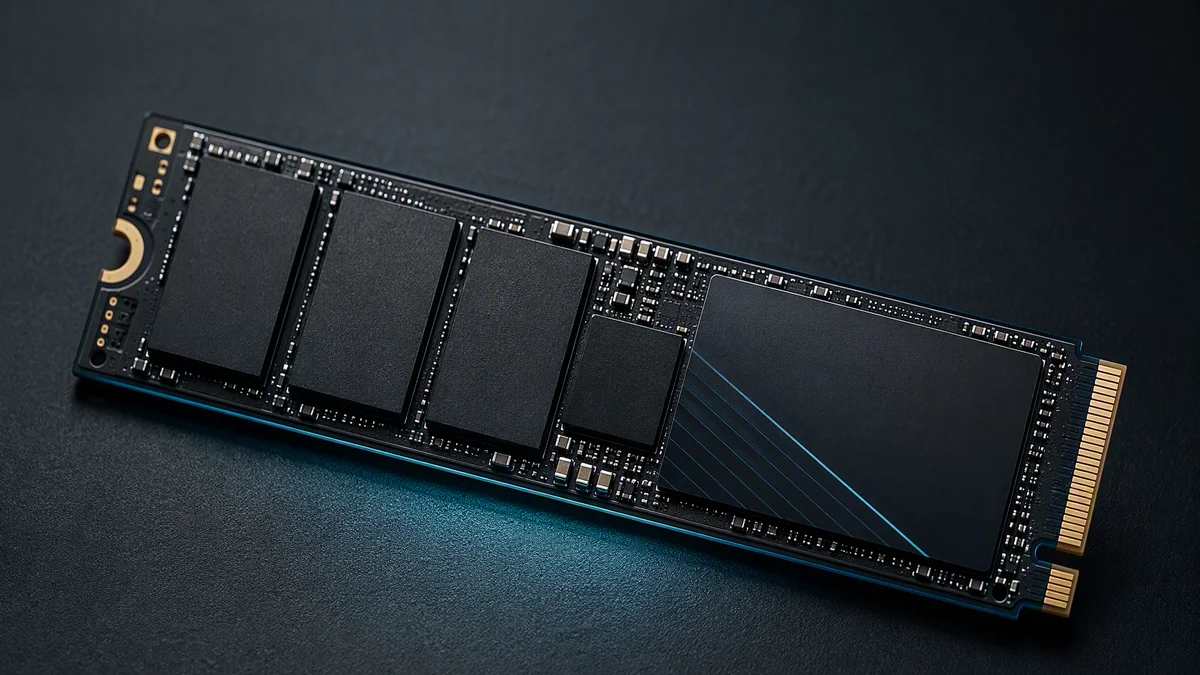
Every storage generation has a drive that matters more than the flagship. Not the fastest drive, the important one: the model that drags the new interface down to a price regular humans will pay. For PCIe Gen5, that drive is the Micron 3610. It pairs a DRAMless controller with Micron’s latest QLC flash, and it still hits 11,000 MB/s. That combination should worry every TLC drive priced above it.
Key Takeaways
- The first PCIe Gen5 SSD arrayed with cost-efficient QLC flash at this performance level.
- Up to 11,000 MB/s sequential reads, comfortably beyond any Gen4 drive.
- DRAMless design uses host memory buffer technology to keep costs and power down.
- Arrives right as the memory price crisis makes affordable high-capacity SSDs essential.
QLC grows up
QLC flash, storing four bits per cell, has always been a trade: density and price in exchange for write endurance and native write speed. Early QLC drives were fine until you filled the cache, at which point performance fell off a cliff into hard drive territory. Micron’s latest QLC is a different animal. The underlying flash is faster per plane, the controller’s caching algorithms are smarter about managing the SLC cache, and the result is a drive that behaves like a mainstream TLC model in everything short of sustained, disk-filling writes.
The DRAMless half of the equation deserves equal credit. Instead of a dedicated DRAM chip for mapping tables, the 3610 borrows a slice of your system memory over the NVMe host memory buffer feature. That removes a component that has become painfully expensive in the current DRAM market, and it is a big part of why this drive can exist at its price at all.
Specs at a glance
| Specification | Micron 3610 2TB |
|---|---|
| Form factor | M.2 2280 |
| Interface | PCIe 5.0 x4, NVMe |
| Sequential read | Up to 11,000 MB/s |
| NAND | Micron QLC 3D NAND |
| DRAM | None, host memory buffer design |
| Capacities | Mainstream capacities, 2TB tested |
| Target use | Gaming, laptops, mainstream desktop builds |
Benchmarks and real world performance
- Sequential reads at the rated 11,000 MB/s, nearly double the best Gen4 drives.
- Game load times within a whisker of far more expensive TLC Gen5 models.
- SLC cache large enough that everyday writes never touch native QLC speed.
- Idle power low enough to make it a genuine laptop candidate.
In gaming and general desktop use, the honest truth is that you cannot tell this drive from drives costing significantly more. Level loads, shader compilation stutter, file copies in the tens of gigabytes: the 3610 sails through all of it. Push it with a sustained multi-hundred-gigabyte write and you will eventually find the QLC underneath, with speeds stepping down once the cache is exhausted. For a boot and game drive, that scenario is rare enough to be academic.
Why the timing is perfect
Context matters here. Memory prices have been climbing hard as AI datacenter demand eats the world’s DRAM and NAND supply, and we have watched datacenter expansion reshape component markets in real time. A fast, capacious SSD that skips the DRAM chip and uses the densest flash available is not just a good product; it is the right product for this exact moment in the market.
Where it fits in your build
The 3610 makes the most sense as a gaming and general-purpose drive in a Gen5-equipped desktop or a modern laptop, where its low idle power and modest thermals are as valuable as its speed. Creators hammering drives with sustained multi-terabyte writes should still look up-market at TLC flagships like the one in our Samsung 9100 PRO review, whose DRAM cache and TLC flash shrug off workloads that would slow the Micron.
Everyone else should pay close attention, because this is the shape of mainstream storage for the next couple of years. If the 3610 is priced where we expect, the only reason to buy a Gen4 drive in a new build will be that your motherboard lacks the slot.
The verdict
Endurance and the warranty question
QLC endurance ratings are lower than TLC on paper, and Micron is transparent about that. What the raw figure misses is scale: for a gaming and general-use drive, even a QLC endurance rating translates to writing the equivalent of a large game every single day for years before you approach the limit. The failure mode people actually encounter, a dead controller or firmware bug, has nothing to do with bit density. Micron backs the drive with a standard five-year warranty, which tells you how worried the company itself is.
There is also a laptop angle worth stressing. DRAMless designs with modern controllers are typically gentler on battery than their DRAM-equipped rivals, and the 3610’s low idle draw makes it an easy recommendation for a notebook upgrade where thermals and watt-hours matter as much as throughput.
It is also worth noting what this drive signals for the market. When the value option posts numbers that embarrassed flagships eighteen months ago, the entire pricing ladder has to reshuffle. Expect TLC Gen5 drives to get cheaper in response, which makes the 3610 important even to people who never buy one.
Technical documentation is available on Micron’s official SSD pages.
The people’s Gen5 drive
What we loved
- 11,000 MB/s from value-oriented QLC flash is genuinely impressive
- DRAMless design sidesteps the memory price crisis
- Real world speed indistinguishable from premium drives in daily use
- Laptop-friendly power and thermals
What needs work
- Sustained writes eventually fall to native QLC speeds
- Lower endurance ratings than TLC flagships
- Not the right tool for heavy workstation write workloads
The Micron 3610 is not the fastest SSD you can buy, and it does not care. It delivers the Gen5 experience at a price that actually moves the market, and in 2026 that is the more important job. For gaming rigs and laptops, this is our new default recommendation. Read about how we test on our review methodology page.
Unsure whether QLC fits your workload? Ask the team for a straight answer.

Alex Mercer is the managing editor of Tech News Xplore. A hardware journalist for over a decade, he has benchmarked more CPUs, GPUs and handhelds than he can count, and leads the publication's testing methodology and editorial standards.