OpenAI’s next hardware bet: a doughnut-shaped smart speaker with moving parts
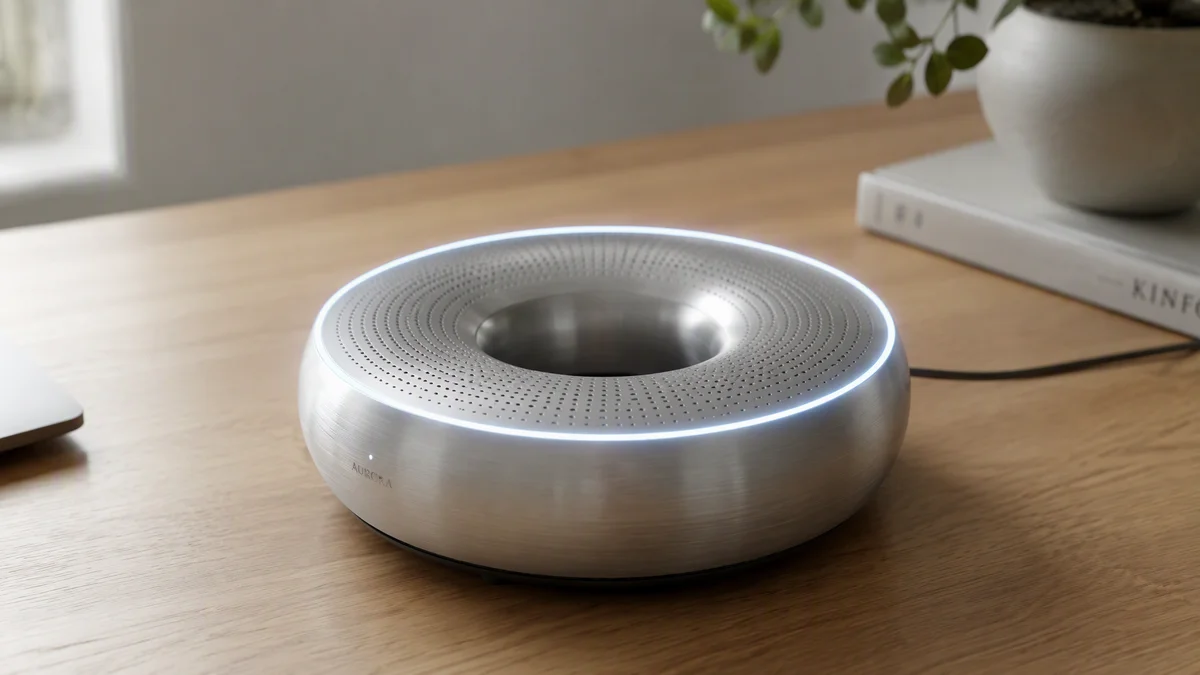
OpenAI’s first hardware product was a $230 programmable keypad for developers. Its second swing is considerably stranger: a doughnut-shaped smart speaker, designed with Jony Ive’s LoveFrom studio, priced between $300 and $400, built from premium metal, and fitted with parts that physically move when it talks to you. The ambition behind it is nothing less than replacing the smartphone as your primary AI interface.
Key Takeaways
- OpenAI is reportedly developing a doughnut-shaped smart speaker targeting a 2027 launch.
- The device is designed with LoveFrom, Jony Ive’s studio, in premium metal with lights, a camera and sensors.
- Moving parts will physically animate the speaker when it responds, to make it feel alive.
- The reported $300 to $400 price positions it far above conventional smart speakers.
What the report actually says
The details come from Bloomberg’s Mark Gurman, whose hardware track record is about as reliable as this industry gets. The picture: a premium metal device with a distinctive ring form factor, a camera system and sensors for perceiving its environment, integrated lighting, and a mechanical party trick, components that move when the assistant speaks, giving the object a physical presence that static speakers lack. The target window is 2027.
The reported price band, $300 to $400, tells you this is not a competitor to the $50 puck speaker. OpenAI is aiming at the space between smart speaker and companion device, a category that has killed every company that tried it. The difference this time, presumably, is that the assistant inside is the one hundreds of millions of people already talk to weekly.
The Jony Ive factor
LoveFrom’s involvement is the whole ballgame for how seriously to take this. Ive’s studio does not license its name to gadgets; it designs objects meant to define categories. The doughnut shape, the materials, the mechanical movement: these are signatures of a team trying to make an AI feel like an object you live with rather than a service you query. Whether that works is an open question, but it will not fail for lack of design conviction.
Moving parts: gimmick or the point
The kinetic element sounds like a novelty until you consider what it replaces. Voice assistants have always suffered from a presence problem: you talk to a cylinder, and a disembodied voice answers from nowhere. Physical movement is a direct attack on that abstraction, giving the response a location and a body language. It is the same instinct that put faces on robots, executed with Ive-grade restraint. If it lands, every static speaker will look broken by comparison. If it does not, it will look like a very expensive desk toy.
The camera in the room
The detail that will generate the most friction is not the shape or the price; it is the camera system. A device with eyes, ears and an always-listening assistant, sitting in your kitchen or bedroom, raises the privacy stakes well beyond what a speaker ever did. OpenAI will need to answer questions Amazon and Google spent a decade fumbling: what is recorded, what is processed locally, what leaves the device, and how a user can tell. The company’s trust position on this is untested, and hardware makes data practices physical in a way software terms of service never did.
The sensor suite is also the product’s bet, though. An assistant that can see what you are cooking, reading or fixing is categorically more useful than one that can only hear. The whole industry is converging on multimodal ambient AI; OpenAI is simply the first to aim a purpose-built object at it.
From Codex Micro to companion device
The product trajectory is worth noting. OpenAI’s first hardware, the Codex Micro keypad, was a cautious niche object for developers. Jumping straight from that to a mainstream companion device is a statement of intent: the company does not see itself as a model provider renting access through other people’s devices. It wants to own the interface layer, and hardware is the only interface Big Tech cannot take away from it.
The phone-replacement delusion, examined
Every AI hardware pitch eventually says the quiet part: replace the smartphone. Humane tried a pin, Rabbit tried a pocket box, and both learned that the phone’s gravity is not about hardware novelty but about the thousand apps and habits lashed to it. A smart speaker has the additional problem of being nailed to a room. The realistic version of OpenAI’s ambition is not killing the phone; it is becoming the device you talk to when the phone is across the room, and capturing the home before competitors do.
That is still a huge prize, and it connects to everything else the company is building. An ambient device plus the coding tools plus the chat assistant is a platform play, not a gadget play. The broader AI hardware race is heating up on every front, from NVIDIA’s RTX Spark laptops to whatever ships from this program in 2027.
The competitive frame makes the timing interesting. Amazon is rebuilding Alexa around generative AI, Google is folding Gemini into its home devices, and Apple is widely expected to push harder into the home with its own assistant hardware. OpenAI entering that arena with an Ive-designed object in 2027 is not a random experiment; it is a bid to be the assistant layer for the home before the incumbents finish their generative transitions. The company that wins the ambient slot in the next two years may hold it for a decade.
There is a design-historical irony worth savoring. Jony Ive spent years at Apple removing buttons, seams and moving parts in pursuit of objects that felt inevitable and still. His studio now reportedly signs on to build a device whose signature feature is that it moves. It reads as a thesis statement about what AI hardware needs that phones never did: a body language. Whether the market agrees is a 2027 question, but it confirms nobody involved thinks a static puck with a chatbot inside is enough.
OpenAI’s product announcements, when official, will appear on OpenAI’s official site.
The bottom line
A doughnut speaker with moving parts sounds absurd until you remember who is designing it and whose assistant lives inside. OpenAI is not building a speaker; it is building the physical body for ChatGPT, with Jony Ive grading the homework. At $300 to $400 it will not be for everyone. It is not supposed to be.
Would a moving AI speaker earn a spot in your home? Tell the tech desk.

Alex Mercer is the managing editor of Tech News Xplore. A hardware journalist for over a decade, he has benchmarked more CPUs, GPUs and handhelds than he can count, and leads the publication's testing methodology and editorial standards.
1 reader comment