ASUS ROG Strix GeForce RTX 5070 Ti 16GB OC Edition Review – Premium Design, Premium Performance
Affiliate disclosure: some links in our reviews may be affiliate links. If you buy through them we may earn a commission at no extra cost to you. Our verdicts are never influenced by partners.
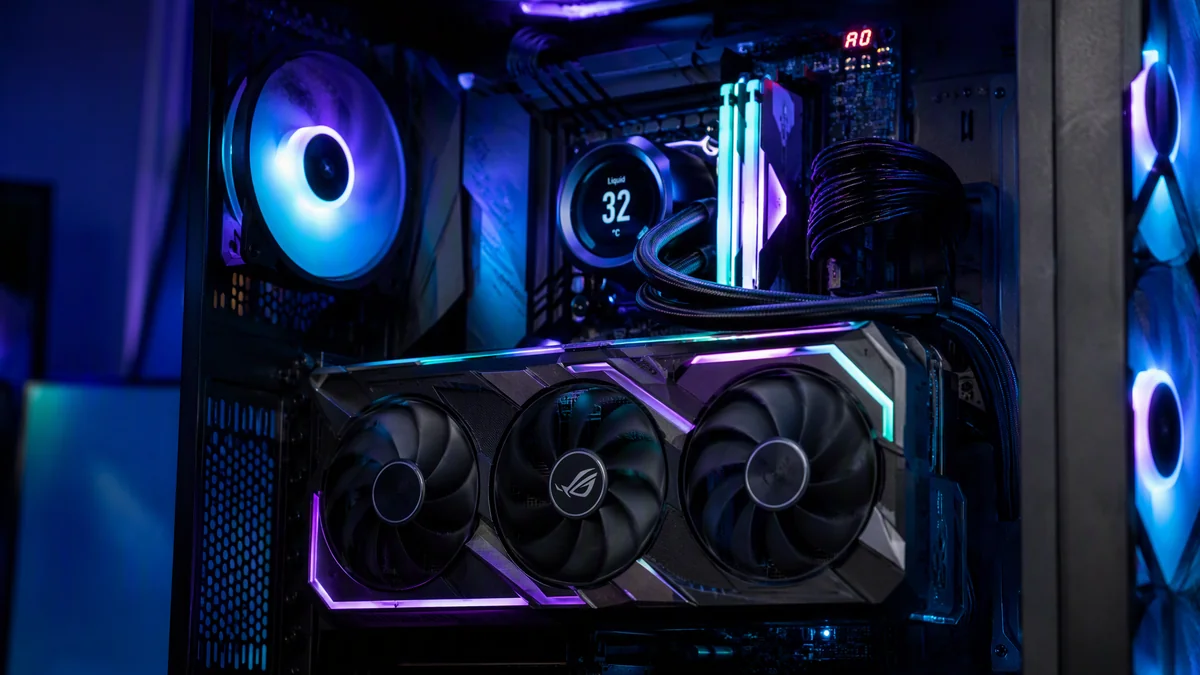
There is a moment in every GPU review where the cooler either justifies its existence or doesn’t. Thirty seconds into our thermal run on the ROG Strix RTX 5070 Ti OC, the fans hadn’t even spun up. This, I thought, glancing at a silent test bench, is what the premium buys you.
Key Takeaways
- RTX 5070 Ti delivers excellent 1440p and very capable 4K performance with 16GB of GDDR7.
- The Strix cooler is massive, quiet and keeps boost clocks pinned.
- Factory overclock adds a few frames; the thermal headroom adds more.
- Premium pricing over MSRP models is the only real argument against it.
Design: big, brushed and unapologetic
The Strix line has an aesthetic and this card commits: a hulking 3.2 slot shroud, angular lines, addressable RGB along the edge and a full metal backplate with a tasteful cutout for passthrough airflow. It is heavy enough that ASUS includes a support bracket, and you should use it. Under the shroud sits the company’s current top air cooling stack: a vapor chamber, dense fin stacks and three Axial-tech fans with a zero RPM mode that our opening anecdote proves works.
Specifications
| Specification | ROG Strix RTX 5070 Ti OC |
|---|---|
| GPU | NVIDIA GeForce RTX 5070 Ti (Blackwell) |
| Memory | 16GB GDDR7, 256 bit bus |
| Boost clock | Factory OC above reference specification |
| Cooling | 3.2 slot triple fan, vapor chamber, zero RPM mode |
| Power | 16 pin 12V-2×6, dual BIOS (Performance / Quiet) |
| Outputs | 3x DisplayPort 2.1, 2x HDMI 2.1 |
| Dimensions | Full length, 3.2 slots, support bracket included |
Benchmarks
- 1440p raster: averages well past 100 fps across our AAA suite at max settings, this card’s natural habitat.
- 4K raster: fully playable with modest settings discipline; upscaling and frame generation turn it into genuine 4K headroom.
- Ray tracing: Blackwell’s RT improvements show clearly, path traced titles that were slideshows two generations ago now run smoothly with upscaling.
All results were captured on our standard GPU bench: Ryzen X3D class CPU to remove bottlenecks, resizable BAR enabled, latest public drivers, three run averages. The complete protocol lives on our review methodology page. For the CPU side of that bench, see our Ryzen 7 9850X3D review, which is the chip doing the feeding in these numbers.
Versus the reference specification, the factory overclock buys two to four percent. Versus cheaper partner cards, the real Strix advantage is not the OC; it is that the cooler holds maximum boost indefinitely without sounding like a drone strike. Quiet BIOS mode shaves a degree or two of temperature for a frame or two, and it is the mode we left it in.
Thermals and acoustics
Peak core temperature in our thermal loop stayed in the low 60s Celsius with fans under 40 percent, memory junction comfortably clear of concern, and coil whine on our sample limited to faint chatter in extremely high fps menus. This is one of the best air coolers we have tested this generation, full stop.
Build quality and the ownership experience
Premium cards justify themselves in the years after the review, and the Strix formula is built for that timeline. The fan bearings are the dual ball type rated for the long haul, the power stages are generously specified with visible headroom, and the shroud disassembles without voiding anything for the deep clean every card eventually needs. GPU Tweak III handles fan curves and monitoring competently if you want it, and stays out of your way if you don’t, which is all we ask of vendor software in 2026.
The dual BIOS switch deserves its praise: physical, reachable through the slot bracket area, and genuinely distinct between modes. Quiet mode became our daily setting within an hour of testing and never got switched back until the benchmarks demanded it.
Power and pairing
The 12V-2×6 connector wants a modern, quality power supply; we tested on an 850W ATX 3.x unit and recommend nothing less for transient headroom. Case clearance is the other homework: measure your case against a full length 3.2 slot card before ordering, and route the power cable with a gentle bend rather than a hard crease. These are five minute checks that prevent very expensive lessons.
Where it sits in the stack
The 5070 Ti occupies the sensible end of the high end: meaningfully faster than the standard 5070, with 16GB of fast GDDR7 that should age gracefully as texture budgets grow, and priced well below the flagship tier where cards like ZOTAC’s anniversary RTX 5080 play. For a 1440p high refresh build, or a 4K build willing to lean on upscaling, it is the tier we would spend our own money on.
Upscaling, frame generation and the 16GB question
Blackwell’s feature stack matters at this tier more than raw silicon gains suggest. The latest DLSS upscaling is now good enough that Quality mode at 4K is effectively free clarity, and frame generation, while no substitute for native frame rates, turns smooth into smoother on high refresh displays. The 16GB of GDDR7 addresses the anxiety that dogged lesser cards: texture budgets in recent releases have punished 8GB configurations hard, and 16GB buys comfortable runway for this console generation’s back half and beyond.
The verdict
Full specifications are listed on the official ASUS product page.
Premium cooler, premium price, earned
What we loved
- Superb cooling: silent at idle, quiet under load
- 16GB GDDR7 with genuine 4K capability
- Dual BIOS and quality of life extras done right
- Excellent 1440p high refresh performance
What needs work
- Meaningful premium over MSRP partner cards
- 3.2 slot size needs case clearance checks
- Factory OC adds little raw performance
The ROG Strix tax is real, and so is what it buys: the quietest, coolest, most overbuilt RTX 5070 Ti we have tested. If your budget says MSRP card, buy one and lose nothing but decibels. If your build deserves the best air cooler in the class, this is it. The fans never spun up in that first thermal run; by the end of testing, neither did our doubts.
Choosing between partner cards? Ask the team which 5070 Ti fits your case and budget.

Alex Mercer is the managing editor of Tech News Xplore. A hardware journalist for over a decade, he has benchmarked more CPUs, GPUs and handhelds than he can count, and leads the publication's testing methodology and editorial standards.
2 reader comments