Steam Frame Reservations Leave Thousands Waiting as Valve’s Launch Lottery Meets Heavy Demand
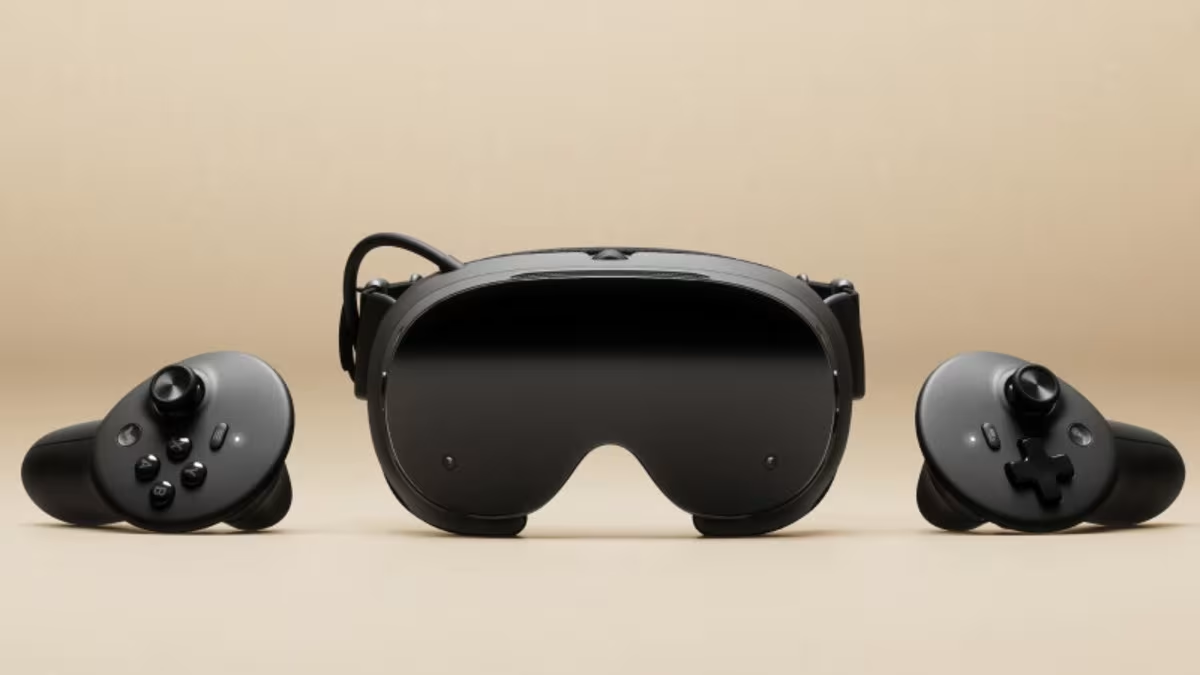
Valve’s new Steam Frame has barely entered the market, and getting one may already be harder than many PC gamers expected.
Community tracking around the headset’s reservation lottery suggests that fewer than 19,000 participating users initially reported landing in Valve’s reservation queue, while a large portion of respondents ended up on the waitlist instead.
There is an important distinction, though: this is not an official Valve sales or production figure. Valve has not publicly disclosed how many people registered for the Steam Frame lottery or exactly how many headsets were available in its first allocation.
Still, the early data paints a clear picture. Interest is colliding with deliberately limited availability.
Key Takeaways:
- Community tracking suggests fewer than 19,000 respondents initially secured Steam Frame reservation-queue positions.
- The figure is self-reported and should not be treated as Valve’s official sales or shipment total.
- Valve used a randomized reservation system instead of a traditional first-come, first-served launch.
- The Steam Frame starts at $1,059 for 256GB, while the 1TB model costs $1,299 in the US.
- Waitlisted buyers do not currently have a guaranteed public date for when their position will move into the reservation queue.
Steam Frame demand runs into limited launch inventory
The Steam Frame officially launched on September 14, 2026, with Valve opening registrations for two configurations: a 256GB headset priced at $1,059 and a 1TB version at $1,299.
Instead of simply putting available inventory on sale and watching the store collapse under launch-day traffic, Valve created a limited registration window.
Sign-ups remained open until September 17 at 10 a.m. Pacific. Valve then randomized eligible registrations and divided customers between a reservation queue and a waitlist.
That distinction matters.
Getting into the reservation queue did not necessarily mean a Steam Frame shipped immediately. It meant Valve had reserved a place for that customer within its available allocation. Purchase invitations are then distributed as units become ready to ship.
Customers placed on the waitlist sit beyond that initial allocation and must wait for Valve to make additional hardware available.
According to community-generated tracking data reported around the launch, fewer than 19,000 participants had reported receiving reservation status, while a larger group reported being waitlisted.
Another snapshot of the tracker recorded roughly 44.7% of respondents as reserved, 51.6% as waitlisted and 3.8% still waiting for an email. Because participation is voluntary, those percentages cannot be extrapolated directly into Valve’s worldwide production numbers.
In other words, the tracker is useful for understanding the launch experience — but it is not a census.
Valve is using a lottery instead of rewarding whoever clicks fastest
Valve’s approach is unusual compared with the typical hardware launch, but there is logic behind it.
A first-come, first-served sale heavily favors users with fast internet connections, prepared payment information and, unfortunately, automated purchasing tools.
The Steam Frame system instead accepted eligible registrations during a multi-day window and randomized their order afterward.
Valve’s official terms also introduced several anti-abuse measures. Participants needed a qualifying Steam account, automated registrations could be rejected, and purchases were limited to one product per household under the program.
Those restrictions cannot eliminate reselling entirely, but they raise the barrier compared with an unrestricted checkout race.
Valve has also given selected buyers a limited purchase window. Once a purchase email arrives, the link remains active for 72 hours. If the customer does not complete the purchase, that opportunity expires.
That could gradually create openings for people further down the queue.
Why a $1,059 headset can still generate a substantial queue
The most interesting part of the Steam Frame situation may be the demand itself.
At $1,059, this is clearly not positioned as an inexpensive mass-market VR headset. The 1TB configuration climbs further to $1,299.
Yet Valve is selling more than a conventional standalone headset.
Steam Frame is designed for both VR and traditional games, with wireless PC streaming alongside standalone functionality. Valve says more than 100 games were already Steam Frame Standalone Verified at launch, with additional titles expected over time.
Half-Life: Alyx is also included with the hardware.
That combination creates an interesting proposition for the enthusiast PC audience. Instead of building a completely separate software ecosystem around the headset, Valve is tying Steam Frame directly into a platform millions of PC gamers already use.
Readers following Valve’s growing hardware ambitions can find additional PC gaming, graphics and hardware coverage on TechNewsXplore.
The early reservation response suggests there is at least meaningful enthusiast interest in that idea despite the premium price.
The 19,000 figure does not mean Valve only built 19,000 headsets
This is where the early numbers can easily become misleading.
There is currently no public confirmation that Valve produced only 19,000 Steam Frames, sold exactly 19,000 units, or received only around 40,000 registrations.
The numbers circulating publicly originate from a community tracker populated by people voluntarily reporting their reservation results.
Valve itself has confirmed the structure of the lottery, the reservation queue and the waitlist, but it has not published an official breakdown of the number of customers in each group.
That means claims about Valve deliberately manufacturing a specific number of units, exact sell-through rates or how long the full waitlist will take to clear remain speculation unless the company releases more information.
What we can say with confidence is that Valve expected demand to exceed immediately available inventory. Its official documentation explicitly distinguishes customers inside the available reservation allocation from those whose randomized position falls beyond it.
Steam Frame’s real launch test starts now
The lottery was only the first hurdle.
The bigger question is how quickly Valve can convert the waitlist into actual purchases.
If new units enter the reservation queue quickly, the frustration surrounding the initial lottery could fade within weeks. If movement remains slow, however, Steam Frame risks becoming another desirable piece of gaming hardware that enthusiasts discuss far more often than they can actually buy.
For Valve, that makes production and fulfillment almost as important as the headset itself.
Steam Frame already has plenty of attention. Now Valve needs to prove it can turn that attention into hardware sitting in gamers’ homes rather than names sitting on a waitlist.
For more PC gaming, VR and hardware coverage, visit TechNewsXplore.
Official Sources
Valve — Steam Hardware announcement: Steam Frame launch, pricing and reservation process
Read the official Steam Hardware announcement
Valve — Steam Frame Limited Drop Program Terms
Read Valve’s official reservation and lottery terms
Steam — Steam hardware storefront
View Steam Frame on Steam’s hardware catalog

Alex Mercer is the managing editor of Tech News Xplore. A hardware journalist for over a decade, he has benchmarked more CPUs, GPUs and handhelds than he can count, and leads the publication's testing methodology and editorial standards.