Nuclear fusion milestone: scientists sustain record-breaking plasma reaction for over 20 minutes
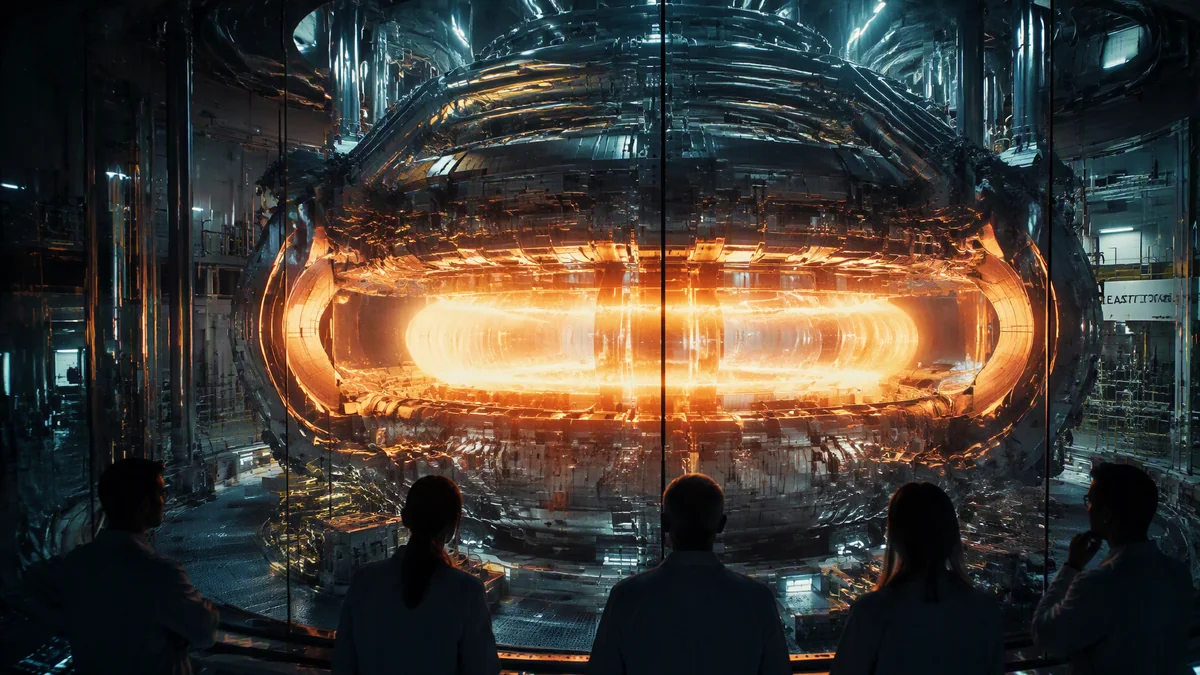
Fusion has been “twenty years away” for sixty years. It is the oldest joke in energy, and honestly, we have all earned the right to be cynical. Which is why this week’s result deserves your attention: a sustained, stable fusion plasma held for over twenty minutes, a duration record that moves the joke’s punchline further than it has moved in decades.
Key Takeaways
- Researchers sustained a fusion plasma for more than 20 minutes, a new duration record for this class of reactor.
- Long duration operation is the unglamorous bottleneck between fusion experiments and fusion power plants.
- Advances in magnetic control and real time plasma feedback made the record possible.
- Commercial fusion remains years away, but the timeline keeps compressing.
Why duration is the frontier
Headline fusion coverage usually fixates on two numbers: temperature and net energy. Both matter. But the number that decides whether fusion ever powers your home is duration. A power plant cannot run on three second bursts. It needs a plasma that sits there, hour after hour, fusing steadily while engineers manage heat exhaust, fuel injection and the hundred instabilities that hot plasma invents to ruin your day.
That is what makes twenty-plus minutes significant. It demonstrates that the control systems, magnetic confinement and materials can hold the line not for a demonstration instant but for a working shift. The plasma did not fizzle, did not disrupt, did not scorch a wall. It just kept burning.
How they held it together
The result rests on three pillars that have each matured enormously over the past decade. First, magnetic confinement: modern superconducting magnets shape fields that keep the hundred million degree plasma from touching anything solid. Second, real time control: machine learning assisted feedback systems now adjust magnetic shaping thousands of times per second, catching instabilities as they form rather than after they bloom. Third, materials: tungsten armored walls and advanced divertors that wick away the helium ash and heat the reaction produces.
None of these is individually new. What is new is all three holding together, continuously, for the length of a sitcom episode. Integration is where experimental physics goes to die, and this time it did not.
The machine learning angle
The control story deserves a beat of its own. Plasma behavior is chaotic in the formal sense: tiny perturbations cascade into disruptions that can end a shot or damage a reactor. Classical control theory helped, but the step change came when teams began training controllers on simulated plasmas and deploying them on real machines. The record run leaned heavily on that approach. It is one of the cleaner examples of AI earning its hype: not writing poetry, but keeping a star in a bottle for twenty minutes.
The global race behind the record
Records like this one never happen in a vacuum, and the context makes it more impressive, not less. Magnetic confinement programs across Europe and Asia have been trading duration milestones for years, each pushing confinement times from seconds to minutes. In parallel, American private companies are pursuing alternate architectures, from compact tokamaks built on high temperature superconductors to stellarators, inertial approaches and magnetized target concepts. The diversity is the point: after decades of betting on essentially one design, the field is now running several races at once, and every approach is learning from the others’ failures in near real time.
What has changed most is the economics of iteration. Superconducting magnet advances collapsed the size and cost of prototype machines, simulation cut years off design cycles, and private capital added a deadline culture that pure public science never had. The twenty minute record is a product of that environment as much as of any single breakthrough.
The fuel question
One bottleneck rarely makes headlines: tritium. The easiest fusion reaction to achieve burns deuterium and tritium, and tritium barely exists in nature. Future power plants must breed it from lithium inside the reactor blanket, a trick demonstrated only at small scale so far. Duration records matter partly because longer burns are exactly the regime where breeding ratios and wall materials get their honest testing.
What this does not mean
Skepticism check, because this field demands it. A duration record is not net energy, and this run was not claimed as a power positive demonstration. The reactor consumed enormous input power to sustain its plasma, as all current machines do. Engineering a plant that runs continuously, breeds its own tritium fuel, survives neutron bombardment for years and produces electricity cheaper than alternatives is a mountain range of remaining problems, not a single summit.
But the joke only lands if nothing ever changes. Things are changing. Private fusion companies have attracted serious capital, multiple reactor concepts are hitting milestones in parallel, and the national programs keep pushing duration and performance records in alternation. The same patience we apply to long horizon tech like the Webb exoplanet chemistry detections applies here: compounding, unglamorous, real.
Why grids would change
If fusion plants ever arrive, they solve the pairing problem that defines modern grids: firm, carbon free power that runs when the sun does not shine and the wind does not blow, with fuel measured in kilograms per year and no long lived waste stream comparable to fission. That future is what justifies the staggering engineering effort, and it is why a twenty minute plasma in a research machine can matter to people who will never see the machine itself.
The road from record to reactor
The next milestones to watch are the boring-sounding ones: hour class plasma durations, integrated fuel cycle demonstrations, and pilot plant designs that aim to put actual electrons on an actual grid in the 2030s. Several public and private programs have published timelines to that effect, and results like this one are why those timelines are no longer laughed out of the room.
The global effort to turn results like this into power plants is documented at the official ITER project site.
The bottom line
Twenty minutes of sustained fusion plasma will not power a single home, and nobody serious claims otherwise. What it does is retire a class of doubt: the doubt that stable, long duration fusion operation is possible at all. The oldest joke in energy is still a joke. But the punchline is coming, and for the first time in sixty years, the delivery keeps improving.
Want more fusion coverage as milestones land? Tell the science desk what you want explained next.

Alex Mercer is the managing editor of Tech News Xplore. A hardware journalist for over a decade, he has benchmarked more CPUs, GPUs and handhelds than he can count, and leads the publication's testing methodology and editorial standards.
1 reader comment