James Webb Space Telescope detects complex organic molecules in a distant exoplanet atmosphere
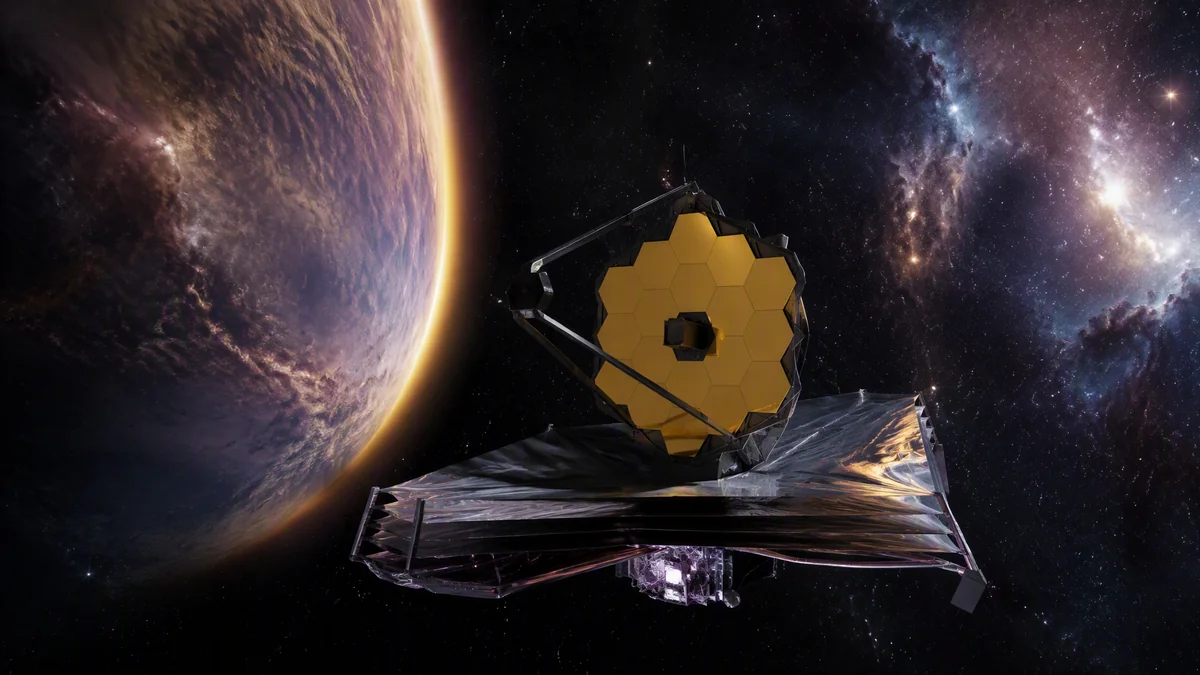
Every generation gets a moment when the universe feels different afterward. Galileo turning a telescope at Jupiter. The first pale blue dot. And now, quietly, in a stream of infrared photons from a world hundreds of light years away: the chemical vocabulary of life, spelled out in an alien sky.
Key Takeaways
- The James Webb Space Telescope detected signatures of complex organic molecules in an exoplanet atmosphere.
- The detection came from transit spectroscopy: starlight filtering through the atmosphere as the planet crossed its star.
- Organic molecules are not life, but they are the raw chemistry life builds from.
- Follow up observations are already planned to confirm and refine the finding.
What Webb actually saw
Let us be precise, because this story deserves precision. Webb did not photograph anything. What it captured was a spectrum: as the exoplanet transited its host star, a sliver of starlight passed through the planet’s atmosphere on its way to us. Molecules in that atmosphere absorbed specific infrared wavelengths, leaving gaps in the spectrum like missing teeth. Those absorption patterns are molecular fingerprints, and among them, astronomers identified signatures consistent with complex organic compounds, carbon bearing molecules more elaborate than the water, methane and carbon dioxide that have become routine detections.
The instrument doing the heavy lifting is Webb’s suite of infrared spectrographs, which can split incoming light finely enough to resolve these features against the glare of a star outshining its planet by orders of magnitude. It is, technically speaking, an absurd thing to be able to do. We are reading the chemistry of a sky we will never visit.
Why complex organics are a threshold
Simple molecules tell you an atmosphere exists. Complex organics tell you chemistry is happening. On Earth, the path from simple atmospheric gases to biology runs through exactly this kind of chemistry: carbon compounds assembling into chains and rings, driven by stellar radiation and whatever energy a world can offer. Finding these molecules on an exoplanet does not mean finding life. It means finding the workshop.
That distinction matters, and the research team behind the detection has been careful to make it. Organic molecules form through non-biological processes too; interstellar clouds are full of them. But their presence in a planetary atmosphere, in combination with the other gases detected, constrains what kinds of chemistry that world can be running, and some of those chemistries are very interesting indeed.
The planet in context
The target is not an Earth twin, and researchers are not claiming otherwise. What makes it valuable is observability: a favorable orbit, a cooperative host star and an atmosphere extended enough to sample. Exoplanet science has always been a discipline of working with what the universe hands you, then squeezing every photon for information. This detection is a masterclass in exactly that.
How confident is the detection
Spectroscopy at this distance is statistics as much as chemistry. The team reports a detection significance strong enough to take seriously but short of the ironclad threshold the field demands for extraordinary claims, which is why the observing proposals for follow up time were filed almost immediately. More transits mean more photons, more photons mean tighter error bars, and tighter error bars mean we will know whether this signal hardens into certainty or softens into a lesson about noise.
This is what good science looks like in public: a striking result, clearly stated uncertainty, and a plan. The same epistemic discipline we ask for in hardware testing applies here, just with telescopes instead of test benches.
How we got here
It is worth remembering how young this entire field is. The first confirmed exoplanet around a sun-like star dates to 1995. The first atmospheric detection on an exoplanet came in 2001. For most of the following two decades, atmospheric characterization meant coarse hints: water vapor here, a haze layer there, mostly on giant planets orbiting scorchingly close to their stars. The instruments could barely distinguish a clear sky from a cloudy one.
Webb changed the resolution of the question. Its mirror collects enough infrared light, and its spectrographs divide that light finely enough, that atmospheric chemistry became a measurement instead of an inference. Water, carbon dioxide, methane and sulfur dioxide detections followed in quick succession across multiple targets. Each one was a headline; each one was also practice. Complex organic signatures are the current frontier of that progression, the point where the chemistry starts to resemble the preconditions we know from home.
Why the caution is justified
The field has been burned before. Announced detections have dissolved under reanalysis, and the statistics of faint signals are merciless. That history is why the team’s measured language matters, and why the follow-up observations matter more than the press release. Science that survives scrutiny is the only science worth reporting.
What comes next
Webb’s schedule is brutally oversubscribed, but atmospheric characterization of promising exoplanets is precisely what the observatory was built for, and follow up campaigns are already in the queue. In parallel, ground based extremely large telescopes coming online this decade will attack the same targets from another angle, cross-checking the chemistry with different instruments and different systematics.
And hovering over all of it is the long game: a future mission concept designed from the ground up to image and characterize true Earth analogs. Detections like this one are how the field builds the case, target list and technical confidence for that mission. If you want a sense of how milestone results build on each other in big science, our coverage of the recent fusion plasma record tells a similar story of patient, compounding progress.
The mission data behind findings like this is public on NASA’s official Webb telescope site.
The bottom line
Webb has found complex organic chemistry written into the atmosphere of a distant world. Not life, not yet, but the alphabet life would be written in. Every generation gets a moment when the universe feels different. This one arrived as a spectrum: quiet, technical and completely extraordinary.
Questions about how transit spectroscopy works? Write to the science desk and we will do a deep dive explainer.

Alex Mercer is the managing editor of Tech News Xplore. A hardware journalist for over a decade, he has benchmarked more CPUs, GPUs and handhelds than he can count, and leads the publication's testing methodology and editorial standards.
1 reader comment