Razer’s new Huntsman is the world’s first low-profile analog optical esports keyboard
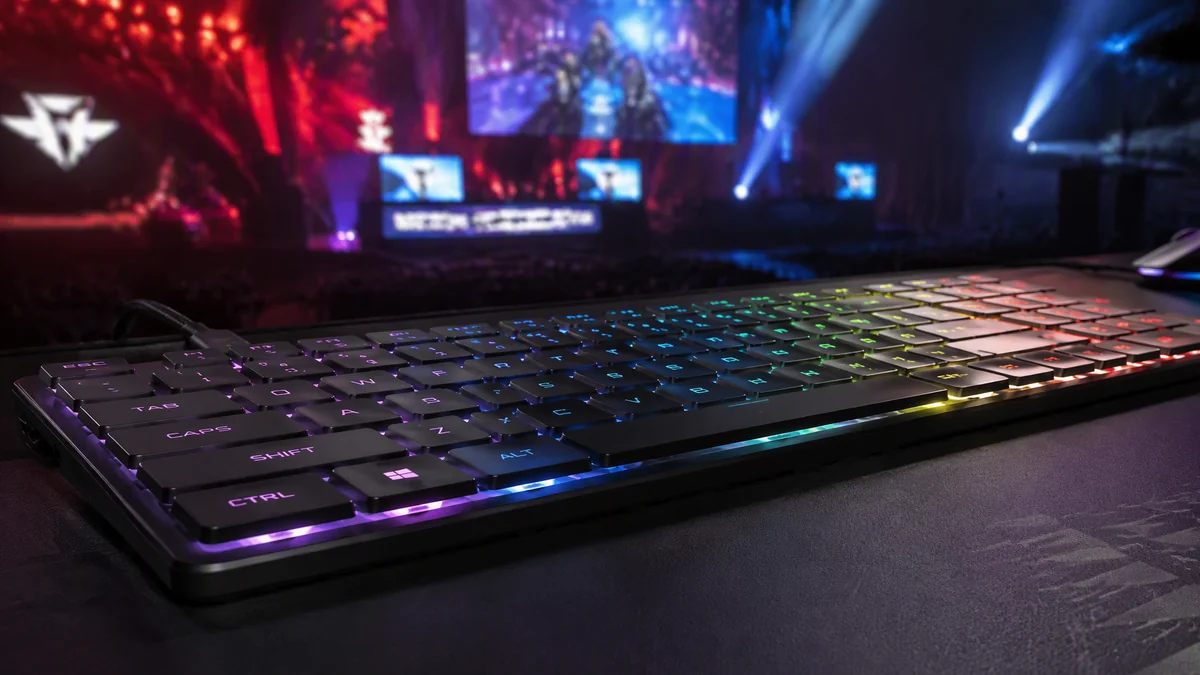
The esports keyboard wars have been fought on two separate fronts: analog switches for speed, and low-profile designs for ergonomics. Razer’s new Huntsman just invaded both territories at once, claiming the title of world’s first low-profile analog optical esports keyboard. Bold claim. The interesting part is that it appears to be true.
Key Takeaways
- The new Huntsman combines low-profile construction with analog optical switches, a market first.
- Adjustable actuation and Rapid Trigger come standard, aimed squarely at competitive play.
- The low-profile form factor targets faster finger travel and better tournament ergonomics.
- It lands in the middle of an analog keyboard arms race that is suddenly very crowded.
What “analog optical” actually buys you
Optical switches register actuation with a beam of light rather than a metal contact, which removes debounce delay and mechanical wear from the equation. Make them analog, and the keyboard stops treating a keypress as binary. It knows how far down the key is, continuously, which unlocks the two features competitive players now demand: adjustable actuation points, and Rapid Trigger, where the key resets the instant it starts traveling upward rather than after crossing a fixed threshold.
For movement-shooter mechanics like counter-strafing, jiggle peeking and slide-canceling, the difference is not theoretical. Millisecond-level reset behavior changes how movement feels, and in a game decided by who stops first, it is a genuine edge.
Why low-profile matters for esports
Full-height keyboards ask your fingers to travel roughly 4mm per keystroke. Low-profile designs cut that dramatically, and shorter travel means faster repeated inputs and less fatigue across a six-hour practice block. The catch has always been switch technology: low-profile boards historically shipped with laptop-adjacent scissor or membrane designs that competitive players would not touch. Putting genuine analog optical switches into a slim chassis is the engineering trick Razer is claiming here, and it is the combination, not either feature alone, that earns the “world’s first” marketing.
We have watched the analog category explode over the past two years, from boutique Hall Effect boards like the IQUNIX EC75 to flagship models from every major brand. Razer’s entry matters because scale matters: when the biggest peripheral brand in esports standardizes a technology, tournament organizers and pro scenes follow.
The spec sheet questions
Details we will verify on the bench: polling rate (8,000Hz is now table stakes at this tier), per-key actuation range and its granularity, onboard profile storage for tournament PCs where software installs are banned, and sound profile, because low-profile optical boards have a distinctive clack that divides rooms. Battery is not a factor here: like every serious esports board, this one is wired, and unapologetically so.
Analog versus Hall Effect: the friendly war
Buyers comparing this board will immediately hit the analog-optical versus Hall Effect question, and the honest answer is that both achieve the same headline features through different physics. Optical analog measures light interruption along the key travel; Hall Effect measures magnetic field strength. Both enable adjustable actuation and Rapid Trigger, both outlive mechanical contacts, and both are now fast enough that implementation quality, firmware tuning, polling behavior and calibration consistency, decides more than the sensing technology itself. We have been impressed by recent Hall Effect boards like the IQUNIX EC75, and the real test for Razer’s optical approach will be matching that consistency in a slimmer chassis.
The software question
Razer’s Synapse remains the brand’s most debated product. The features it enables are genuinely powerful, the resource footprint and account requirements genuinely annoying. A tournament keyboard lives and dies by onboard memory: profiles that travel with the hardware matter more than any cloud sync. We will be checking exactly how much of the Huntsman’s configuration survives a PC with no software installed.
Low-profile keyboards: a quick history
The slim keyboard has lived two lives. First it was the office accessory, thin and forgettable, built for typing pools rather than tournaments. Then custom keyboard culture got hold of low-profile mechanical switches and discovered something interesting: shorter travel, done right, feels fast and precise rather than cheap. Enthusiast builds proved the form factor could be premium. What the segment never had, until now, was the analog switch technology that competitive gaming increasingly demands. Razer’s claim to “world’s first” rests on that specific intersection, and as far as we can verify, the intersection was indeed empty.
It is also worth noting what low-profile analog enables beyond raw speed. Shorter travel combined with adjustable actuation points means a single board can be tuned light and hair-trigger for competition, then deepened for typing, without swapping switches. That flexibility is the practical selling point the spec sheet cannot fully convey, and it is the argument that will win over players who have never considered a slim board before.
Who this keyboard is actually for
The target buyer is specific: the competitive player who trains for hours, values movement mechanics, and has felt wrist fatigue on full-height boards. Typists who love deep travel should look elsewhere; this is a tool built for repetition speed. The broader audience watching this launch is the tournament scene itself. If pros start winning on low-profile analog, every aspiring competitor will notice, and peripheral markets move on what pros win with far faster than on any spec sheet.
The arms race context
Timing is everything here. Analog keyboards have crossed from enthusiast curiosity to competitive necessity in about eighteen months, and every major brand now either ships one or is about to. Razer claiming the low-profile niche first is a smart flanking move: rather than out-spec the crowded full-size analog field, it created a category intersection it can own. Whether competitors follow depends on whether pros actually adopt the slim form factor, which is the real test starting now.
Full switch specifications are on Razer’s official product page.
The bottom line
The new Huntsman merges the two most important keyboard trends in competitive gaming, analog precision and low-profile speed, into one chassis nobody else currently offers. If the switches deliver full analog fidelity at low-profile travel, Razer has not just launched a keyboard, it has launched the next default for tournament desks. The “world’s first” label expires fast in this market. The head start does not.
Low-profile or full-height for competitive play? Debate it with the gaming desk.

Alex Mercer is the managing editor of Tech News Xplore. A hardware journalist for over a decade, he has benchmarked more CPUs, GPUs and handhelds than he can count, and leads the publication's testing methodology and editorial standards.