China’s Tianwen-2 has reached Kamo’oalewa, the tiny quasi-moon it will try to sample
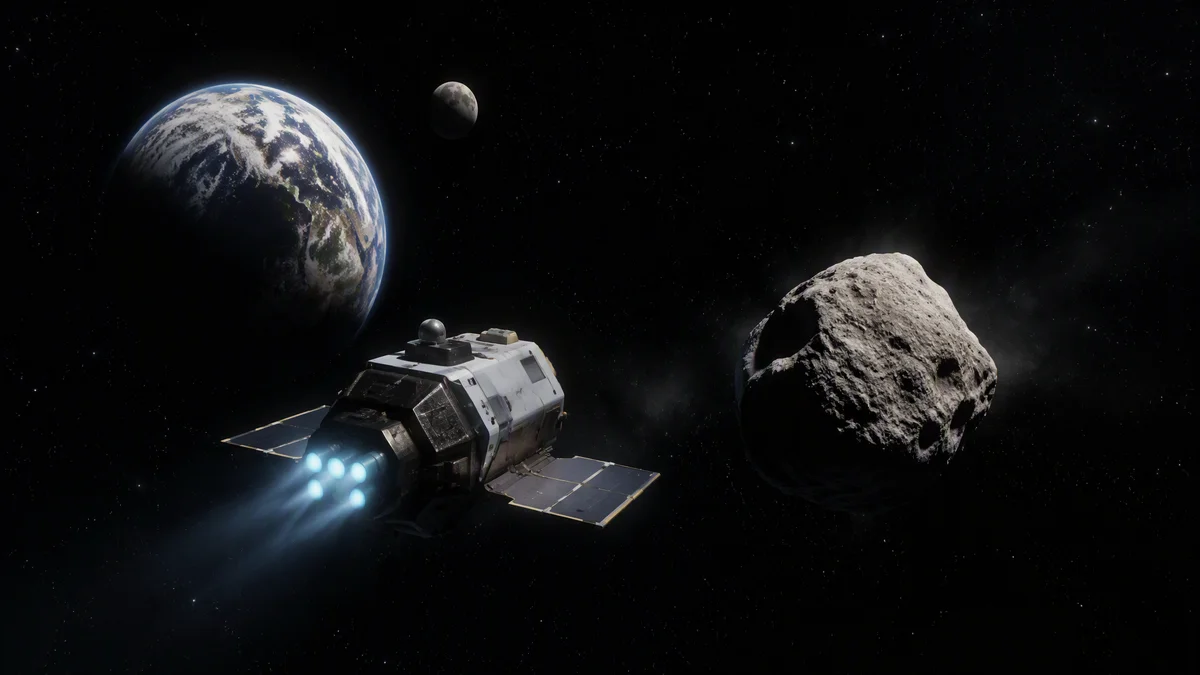
Six hundred and twenty million miles of travel, and the destination is smaller than a house. China’s Tianwen-2 spacecraft, launched in May 2025, has closed to within 12.5 miles of Kamo’oalewa, one of Earth’s seven known quasi-moons, and is now photographing an object no spacecraft has ever visited. If the next phase works, China becomes the third nation in history to bring home a piece of an asteroid.
Key Takeaways
- Tianwen-2 traveled 620 million miles over 400 days to reach Kamo’oalewa.
- The target is only 50 to 60 feet wide and completes a full rotation every half hour.
- The probe will attempt “anchor-and-attach” and “touch-and-go” sampling methods.
- Success would make China the third asteroid-sampling nation, after Japan and the United States.
The hardest target ever chosen
Kamo’oalewa is not a quasi-moon in any comforting sense. It is an asteroid roughly 50 to 60 feet across, trapped in an orbit that keeps it looping near Earth without ever being captured by it, one of only seven such objects known. It is, in the words of planetary scientist Cristina Thomas, the smallest object ever visited by a spacecraft. Everything about rendezvousing with it is harder than the asteroid missions that came before: less gravity to hold an orbit against, less surface to aim at, less margin for every maneuver.
Then there is the spin. Kamo’oalewa completes a rotation every thirty minutes, fast enough that its surface is effectively trying to throw off anything that touches it. A two-ton spacecraft attempting contact has to match that rotation’s geometry with extraordinary precision, or risk being swatted away, or worse, nudging the rock’s trajectory in ways that end the mission’s usefulness.
How you sample a spinning pebble
Tianwen-2 carries two answers to the problem, and the engineering community is watching both. The first is anchor-and-attach: physically securing the probe to the surface, the more ambitious approach and the one the spin makes genuinely daring. The second is touch-and-go, the proven technique of brief contact, a burst of collected material, and immediate retreat, descended from the methods that worked at Bennu and Ryugu. The mission will spend over a year flying alongside the quasi-moon, mapping its composition and rehearsing before any attempt is made.
What a quasi-moon can tell us
The scientific prize justifies the difficulty. Kamo’oalewa’s spectrum suggests it may be a fragment blasted off the Moon itself by an ancient impact, which would make it a piece of lunar history delivered to Earth’s doorstep, no lunar landing required. Even if that origin theory does not survive sampling, a pristine near-Earth asteroid is a time capsule from the solar system’s formation, carrying chemistry that predates every rock on this planet. Sample return turns a point of light into laboratory evidence.
What makes a quasi-moon quasi
The label deserves unpacking, because Kamo’oalewa is not a moon at all in the strict sense. It orbits the Sun, not the Earth, but its orbital period is so closely matched to ours that it appears to loop around our planet in a slow dance that can persist for centuries. Earth never captured it and never will; it is a fellow traveler sharing our lane around the Sun, close enough to visit relatively cheaply in fuel terms, which is precisely why it was chosen.
Only seven such quasi-satellites are known, and each is a candidate for the same trick: near-Earth accessibility with main-belt asteroid science. If Kamo’oalewa sampling succeeds, expect the other six to climb mission priority lists worldwide, because a quasi-moon sample return is among the cheapest deep-space science a space program can buy.
The navigation feat that got it there
Do not let the sampling drama overshadow what already happened. Matching trajectory with a 50-foot object 620 million miles from launch, arriving close enough to photograph it clearly, is a navigation achievement in its own right. Small bodies have barely any gravity to correct against and ephemerides measured with large uncertainties; every kilometer of that approach corridor had to be earned by tracking and thrust. The rendezvous alone puts Tianwen-2 in elite company.
The club China is about to join
Only two nations have returned asteroid samples: Japan, with the Hayabusa and Hayabusa2 missions to Itokawa and Ryugu, and the United States, with OSIRIS-REx and its Bennu samples. Tianwen-2 succeeding at Kamo’oalewa makes China the third, and does so against arguably the most difficult target of the three. It also fits a pattern that is reshaping deep-space exploration: China’s program now executes the class of ambitious, first-of-kind missions that once defined NASA’s monopoly, from the lunar far side to Mars orbit, as our coverage of the new Moon race’s communications infrastructure shows from the American side.
The samples, if all goes well, will not stay secret. China’s recent lunar sample returns have been shared with international researchers under application, and asteroid material from a suspected lunar fragment would be among the most requested extraterrestrial material in decades.
The mission also carries a quieter demonstration effect beyond the science. Executing a small-body rendezvous and sampling attempt validates the exact capabilities, deep-space navigation, autonomous proximity operations, precision touch-and-go mechanics, that any future planetary defense effort would need to deflect a hazardous asteroid. Every agency practicing these maneuvers on harmless quasi-moons is rehearsing for the day one arrives that is not harmless. Science missions and planetary defense are the same skill set wearing different badges.
Whatever the sampling attempt yields, the images coming back now are already rewriting what we know about this odd little world. Every resolved boulder and crater on Kamo’oalewa’s surface is new science, the first close look at a class of object that has only ever been a dot in a telescope. The best views are still ahead of us.
Mission background and quasi-moon science are covered by The Planetary Society.
The bottom line
Tianwen-2 reaching Kamo’oalewa is already a first: no spacecraft has ever visited an object this small, this fast-spinning, this strange. The sampling attempt ahead is harder still, and if it works, China joins the asteroid-return club with the toughest target anyone has attempted. The Moon race has an asteroid leg now, and it is underway.
Is Kamo’oalewa really a piece of the Moon? Tell the science desk your theory.

Alex Mercer is the managing editor of Tech News Xplore. A hardware journalist for over a decade, he has benchmarked more CPUs, GPUs and handhelds than he can count, and leads the publication's testing methodology and editorial standards.