This is what 14 years of driving across Mars does to a rover’s wheels
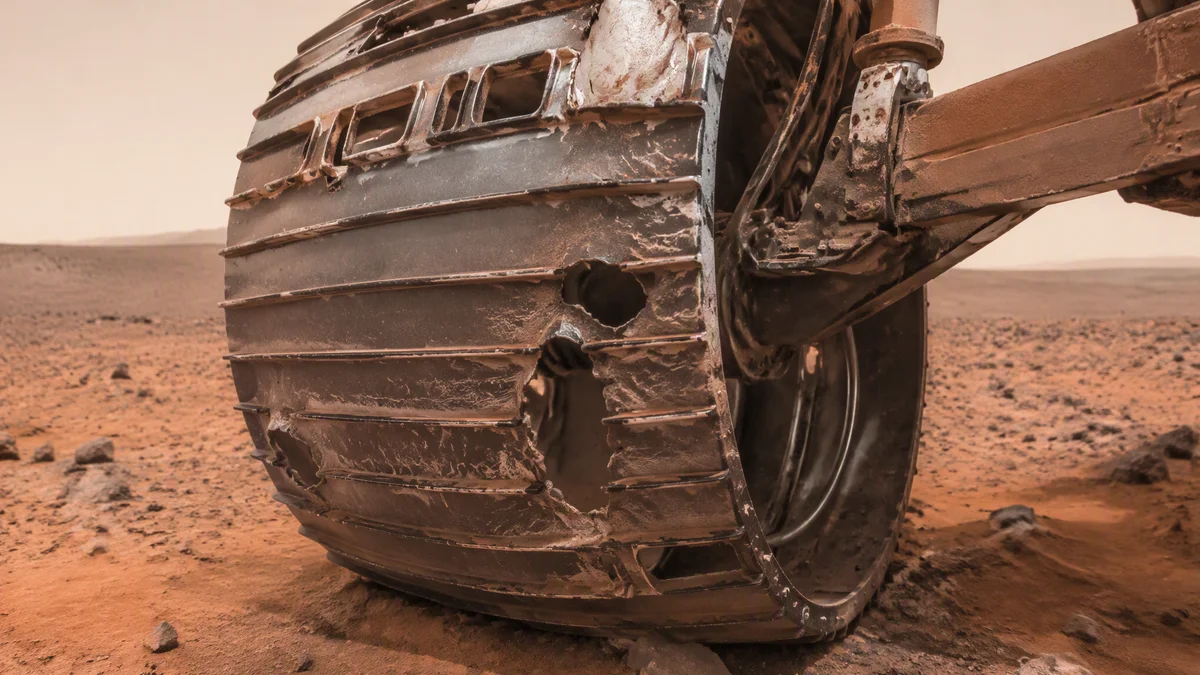
Fourteen years ago, a one-ton rover touched down in Gale Crater and started driving. It has not stopped since. New images of NASA’s Curiosity rover show what over twenty miles of unforgiving Martian rock does to aluminum wheels: jagged holes, torn tread and entire sections simply gone. The remarkable part is not the damage. It is that Curiosity is still going, and NASA intends to keep it going until the wheels literally fall off.
Key Takeaways
- Curiosity’s wheels show jagged holes and missing sections after 14 years on Mars.
- The rover has driven just over 20 miles across rocky terrain since landing in 2012.
- Engineers have managed the wear since 2013 with rerouting and traction-control software.
- NASA has extended the mission indefinitely: the plan is to run Curiosity until it cannot run.
The damage, up close
The wheel images are genuinely startling if you have followed the mission from the start. The clean, chevron-treaded aluminum wheels that rolled off the landing platform in 2012 are now punctured and ragged, with holes you could put a fist through and grousers missing outright. Mars did this one sharp rock at a time. The terrain inside Gale Crater is littered with ventifacts, wind-sharpened stones that act like a endless field of chisels, and every mile driven has been a slow negotiation with them.
Engineers spotted the problem early, with the first unexpected punctures appearing barely a year into the mission. Since 2013, wheel health checks have been a routine part of operations, photographed regularly by the rover’s own cameras so teams on Earth can track each new tear and plan around it.
How NASA kept a wounded rover driving
The response to the wheel crisis is one of the great quiet engineering stories of planetary exploration. Unable to change the hardware, the team changed everything else. Driving routes are now planned to avoid the worst terrain classes identified from orbit and experience. Onboard software was rewritten to adjust traction in real time, reducing the pressure each wheel exerts on sharp contact points. Drive distances are rationed against scientific value: every meter of wheel life is a budget, spent only where the geology justifies it.
The result is that a problem that once looked mission-limiting became mission-manageable. Curiosity is slower and more careful than it was, but it is still climbing Mount Sharp, still drilling samples, still returning science no other platform on Mars can match.
Run it until the wheels fall off
NASA’s official posture says everything about how the calculation has shifted. The mission is extended indefinitely, which is bureaucratic language for a beautifully simple plan: operate Curiosity for as long as it can possibly operate. There is no successor at Gale Crater and no scheduled end. The rover will keep working until a wheel fails beyond recovery, the power system fades, or physics simply wins. It is the same philosophy that kept the Voyagers transmitting decades past their design lives, and it treats the rover’s remaining capability as something to be spent fully, not preserved.
Why Mars eats wheels
The physics of the damage is worth understanding, because it shaped every rover that followed. Curiosity’s wheels are thin aluminum, chosen to save weight, with the assumption that Martian soil would be the main contact surface. The reality of Gale Crater is fields of immobile, wind-sharpened rock embedded in that soil, and a one-ton rover pressing thin metal onto a rock point concentrates enormous stress on a tiny area. The metal does not bend; it punctures, and each puncture then catches and tears further with every subsequent rotation.
The counterintuitive part is that the holes themselves are not immediately fatal. The wheels are designed with internal structure that keeps them rolling even as the outer skin fails, which is why Curiosity can look that bad and still drive. The risk engineers actually watch is a sharp rock wedging into a wheel in a way that immobilizes it, turning a mobility problem from slow degradation into sudden death.
The odometer in context
Twenty miles in fourteen years sounds modest until you remember that every meter is driven by remote control from another planet, with signal delays making real-time driving impossible. Each traverse is planned from orbital imagery, uploaded as a command sequence, and executed autonomously. Curiosity does not commute; it campaigns, and the campaign has now lasted longer than some cars on Earth survive.
What fourteen years bought
The odometer understates the achievement. In those twenty-odd miles, Curiosity confirmed ancient habitable environments in Gale Crater, found organic molecules preserved in Martian rock, measured the planet’s methane mystery and radiation environment, and turned Mount Sharp from a landing-site backdrop into a climbed, sampled mountain. The findings connect directly to the broader search for life-friendly chemistry beyond Earth, the same quest our coverage of Webb’s exoplanet organic detections follows from light-years away.
The wheels also taught the next generation. Perseverance, driving similar terrain in Jezero Crater, rolls on redesigned wheels built with Curiosity’s scars in mind: thicker, tougher, with a different tread geometry. Every hole in those old aluminum wheels is a specification in the new ones.
There is something quietly profound about the wheel images that goes beyond engineering. Every puncture is a place the rover chose to go: a ridge crossed for a rock worth drilling, a detour taken for a vein worth reading. The damage map is, in a very literal sense, the mission’s autobiography written in aluminum. When Curiosity finally stops, those wheels will deserve a museum, because no artifact better captures what planetary exploration actually costs.
Mission updates and the raw image archive are on NASA’s Mars exploration site.
The bottom line
Curiosity’s shredded wheels are not a failure story; they are the receipt for fourteen years of doing exactly what the rover was sent to do. NASA managed the damage with software, rerouting and stubbornness, and now plans to spend every last mile the machine has left. Some hardware retires. The great ones get driven until the wheels fall off.
Should NASA build a successor for Gale Crater? Tell the science desk.

Alex Mercer is the managing editor of Tech News Xplore. A hardware journalist for over a decade, he has benchmarked more CPUs, GPUs and handhelds than he can count, and leads the publication's testing methodology and editorial standards.
1 reader comment