A humanoid robot just climbed a 20,341-foot volcano, and Everest is next
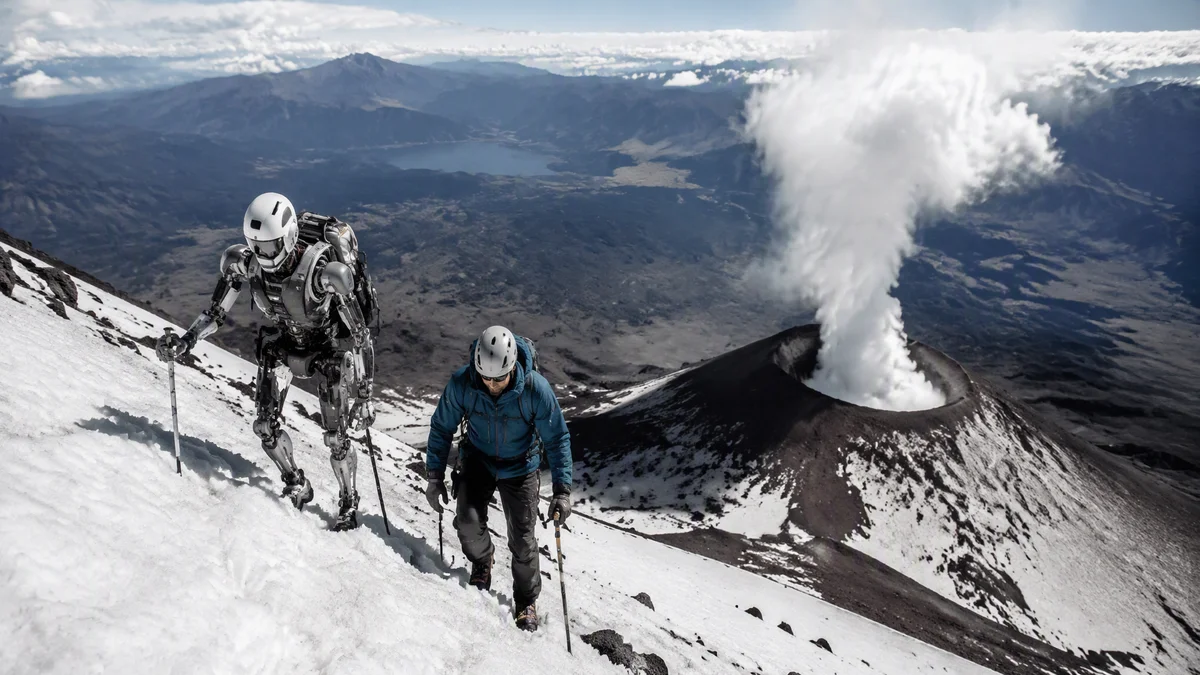
At 20,341 feet on Ecuador’s Chimborazo volcano, the air holds half the oxygen of sea level, the snow hides crevasses, and the cold kills batteries and humans alike. A modified Unitree G1 humanoid robot named Pemba just stood on that summit, the first robot of its kind to get there. It is a mountaineering footnote and a robotics milestone at once, and the team behind it is already looking at Everest.
Key Takeaways
- Pemba, a modified Unitree G1, is the first humanoid robot to summit a 20,000-foot-class volcano.
- The 16-hour Chimborazo trek was walked autonomously on sections below a 30-degree incline.
- The robot wore insulating booties and a warming jacket to survive the conditions.
- The project’s goal is environmental monitoring robots for terrain too harsh for humans.
The climb, honestly assessed
The details matter, because the achievement is real but specific. Pemba completed the 16-hour Chimborazo trek with a support team, walking autonomously across sections with inclines under thirty degrees and being carried over steeper ground. This was not a robot soloing a mountain; it was a robot proving it can operate, walk, balance and endure in one of the most hostile environments on Earth, through snow, altitude and cold that destroy ordinary machines.
The survival kit tells the engineering story. Pemba climbed in specially fitted booties and a warming jacket, because the enemy at altitude is not just terrain but temperature: lithium batteries lose capacity in the cold, lubricants thicken, and materials turn brittle. Getting a humanoid through sixteen hours of that environment, functional at the end, is the actual breakthrough. The summit photo is the souvenir.
Why a humanoid, and why a volcano
The project, organized by a French engineer known as Pablo, has a practical mission behind the spectacle: environmental monitoring in places humans cannot safely or sustainably work. High-altitude climate stations, volcanic gas monitoring, glacier observation, rainforest survey work: the planet’s most scientifically valuable data often lives in its most punishing locations. Helicopters are expensive, satellites are blunt, and human expeditions are slow, costly and dangerous.
The humanoid form factor is the deliberate answer to a specific problem: the world’s monitoring infrastructure, its trails, ladders, stations and equipment, was built for the human body. A robot shaped like us can theoretically use all of it without modification, climbing the same routes and operating the same instruments. Wheels fail on scree and ladders; legs, in principle, do not.
From Chimborazo to Everest
The stated next target is Mount Everest, and the gap between the two is worth respecting. Everest is higher, colder, longer and logistically brutal in ways Chimborazo only hints at. But the progression logic is sound: each climb validates autonomy, endurance and cold-weather survival at a harder level, building toward robots that can work in the Himalayas or the Amazon for weeks at a time. The same philosophy drives machines into other extreme frontiers, a theme our coverage of Curiosity’s fourteen years on Mars follows on another world entirely.
What altitude does to a machine
The engineering challenges of Chimborazo stack up in ways lab testing never replicates. Cold is the headline: battery chemistry slows as temperature drops, cutting available power precisely when walking on snow demands more of it. Low air pressure changes cooling behavior, because fans and heat dissipation systems designed at sea level move less air per rotation up high. Snow and ice attack traction constantly, and every step on a slope is a balance problem with consequences, solved by control systems running on power that is already scarce.
That is why the booties and warming jacket are not cute accessories but the visible edge of a thermal management redesign. Keeping a humanoid’s batteries and joints in their operating range through sixteen hours of alpine conditions is the difference between a demo and an expedition, and it is the part of the achievement that transfers directly to the monitoring missions the project is actually about.
The autonomy line that matters
The detail to file away is the thirty-degree threshold. Below it, Pemba walked on its own; above it, humans carried it. That line is the honest map of where legged autonomy is right now: real and useful on moderate terrain, not yet trustworthy where a fall is fatal. Every future climb that pushes that threshold upward is a measurable step, and it gives the Everest ambition a concrete metric instead of a slogan.
The state of the humanoid race
Pemba’s climb lands in the middle of a genuine humanoid acceleration. The underlying platform, Unitree’s G1, is one of several humanoids moving from laboratory demos into field trials, and the pattern across the industry is the same: the walking and balance problems are largely solved, and the frontier has moved to endurance, autonomy and usefulness. A robot that summits a volcano is still partly a stunt. A robot that works at altitude for a season is a product, and the distance between those two things is closing faster than most people realize.
The honest skepticism belongs in the record too. Humanoids remain power-hungry, slow and fragile compared to purpose-built machines, and the monitoring missions imagined for them could often be done by drones or fixed sensors today. The bet behind Pemba is that general-purpose bodies will win on flexibility what they lose on efficiency. Chimborazo did not settle that bet, but it moved it forward.
The footage itself has done something specifications never could: it made the abstract humanoid debate concrete. Watching a machine trudge through snow at altitude, doing something recognizably arduous, reframes the question from “are humanoids useful” to “where will they work first”. Search and rescue, volcano monitoring, high-altitude maintenance: the shortlist writes itself once you have seen a robot earn its summit. Whatever comes next for Pemba, Chimborazo is already the answer to the skepticism.
The robot platform behind Pemba is documented on Unitree’s official site.
The bottom line
A humanoid on a 20,341-foot summit is equal parts expedition and engineering proof: the cold-weather endurance and autonomous walking are real, the Everest ambition is a stretch, and the environmental monitoring mission is genuinely worthwhile. The age of robots working where humans cannot is not here yet. But it just planted a flag at twenty thousand feet.
What extreme job should robots take over first? Tell the science desk.

Alex Mercer is the managing editor of Tech News Xplore. A hardware journalist for over a decade, he has benchmarked more CPUs, GPUs and handhelds than he can count, and leads the publication's testing methodology and editorial standards.