Cornell’s DEER method restores dead lithium-ion batteries to 95% capacity, without shredding them
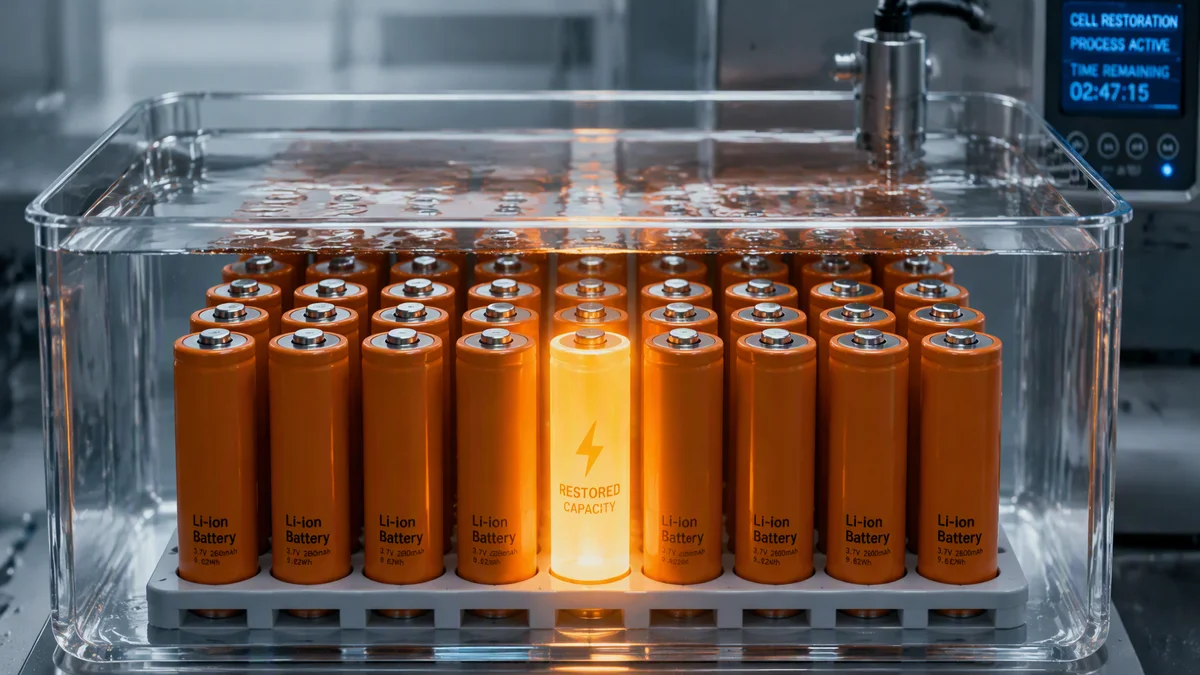
Every lithium-ion battery on Earth is slowly dying the same death, and until now the only answer was to shred it and start over. Researchers at Cornell University have developed a method called Direct Electrode-to-Electrode Regeneration, DEER, that restores aged batteries to as much as 95 percent of their original capacity, with no shredding, no harsh chemistry, and at a fraction of what conventional recycling costs. If it scales, the economics of every electric device change.
Key Takeaways
- DEER restores aged lithium-ion batteries to up to 95 percent of original capacity.
- The process removes the degraded SEI layer from intact electrodes in an electrochemical bath.
- It leaves a protective lithium fluoride layer that slows future wear.
- Conventional recycling shreds electrodes into black mass; DEER keeps them whole.
Why batteries really die
The killer has a name: the solid electrolyte interphase, or SEI. Every charge cycle deposits a little more of this layer on the battery’s electrodes. A thin SEI layer is essential, part of how the battery works at all. But cycle after cycle, it thickens, and the thickening strangles performance: resistance climbs, capacity falls, and eventually a battery whose active materials are largely fine gets retired because the gunk on its electrodes has choked it.
This is the quiet scandal of the battery age. Electric vehicle packs and grid storage systems are routinely replaced while most of their valuable material remains perfectly functional, discarded not because the chemistry died but because an interface layer grew too thick. The recycling industry’s answer has been to accept the loss: shred everything into a powder called black mass, then use energy-intensive chemical processes to extract the raw minerals and build new electrodes from scratch.
How DEER works
DEER rejects the shredding premise entirely. Instead of destroying the electrode to recover its materials, the process removes the electrodes intact, bathes them electrochemically to strip away the thickened SEI layer, and returns the restored electrodes to service in a new cell. The valuable, carefully engineered structure of the electrode, the part that cost real energy and precision to manufacture, survives the entire process.
The elegance is in what the bath leaves behind. Along with stripping the SEI, the process deposits a thin layer of lithium fluoride on the electrode surface, a protective coating that stabilizes it and slows the very degradation that necessitated the treatment. The battery does not just get its capacity back; it gets a measure of resistance to losing it again.
Why this beats the shredder
The comparison to conventional recycling is stark on every axis. Black-mass recycling destroys the electrode’s engineered value and pays heavily in energy and chemistry to recover raw minerals, then pays again to rebuild electrodes from them. DEER preserves the engineered value directly, which is why the cost profile is so much lower: you are restoring a product, not re-manufacturing one from dust. A restoration loop also tolerates imperfection that a materials-recovery loop cannot, because the output only has to work, not to be refined to purity.
The chemistry, without the jargon
Think of a lithium-ion electrode as a busy highway for lithium ions, and the SEI layer as construction debris piling up at the on-ramps. Early on, a little debris actually stabilizes traffic. But it never stops accumulating, and eventually the ramps clog: fewer ions get through per cycle, the battery works harder to push them, heat rises, and the whole system degrades faster in a self-reinforcing loop. Capacity loss is not the highway wearing out; it is the access points closing.
That framing explains why DEER’s approach is so much smarter than shredding. If the problem is debris at the on-ramps, the fix is clearing the debris, not demolishing the highway and rebuilding it from raw asphalt. The electrochemical bath dissolves the SEI selectively, leaving the engineered electrode structure untouched, and the lithium fluoride deposit acts like a sealant that slows the debris from returning.
Where the method fits in the battery lifecycle
DEER does not eliminate recycling; it reorders it. The smart lifecycle becomes use, restore, use again, restore again, and only then shred and recover materials when the electrodes are genuinely spent. Every restoration cycle inserted before the shredder multiplies the value extracted from the same mined lithium, which is the entire environmental argument in one sentence.
What 95 percent would change
Start with electric vehicles. Battery packs are the most expensive component in an EV, and degradation anxiety shapes everything from resale values to warranty terms. A cheap restoration path to 95 percent capacity transforms a depreciating asset into a maintainable one. Grid storage is the second revolution: the buildout of renewable energy depends on vast battery installations whose replacement cycles drive their economics, and restoration at scale bends that cost curve hard. We track the infrastructure side of that buildout in our report on the energy demands reshaping the grid.
The honest caveats belong here too. DEER is a laboratory result, and the path from Cornell’s bench to industrial scale runs through throughput, automation and the messy variety of real-world battery formats. Restoration also is not immortality: a battery can only be regenerated so many times before the underlying materials genuinely degrade. But a technology that doubles or triples effective battery life does not need to be infinite to be transformative.
The consumer electronics angle should not be overlooked amid the EV and grid excitement. Phones, laptops and power tools all die the same SEI death, and a restoration infrastructure that starts with big, valuable battery packs will eventually reach smaller ones if the economics hold. The repairability movement has spent years arguing that devices should be maintainable rather than disposable; DEER is the battery chemistry finally agreeing. The first industry to industrialize it gets both the profits and the environmental credibility.
The research is published by Cornell University.
The bottom line
DEER attacks the battery problem at its actual source: not dead chemistry, but a choked interface that current recycling destroys value to fix. Restoring intact electrodes to 95 percent capacity, cheaply and without shredding, could rewire the economics of EVs, grid storage and everything with a lithium cell. Watch this one scale.
Would a restorable battery change how you buy an EV? Tell the science desk.

Alex Mercer is the managing editor of Tech News Xplore. A hardware journalist for over a decade, he has benchmarked more CPUs, GPUs and handhelds than he can count, and leads the publication's testing methodology and editorial standards.