NASA just streamed 4K video from the Moon at 260Mbps, and it changes everything about deep space missions
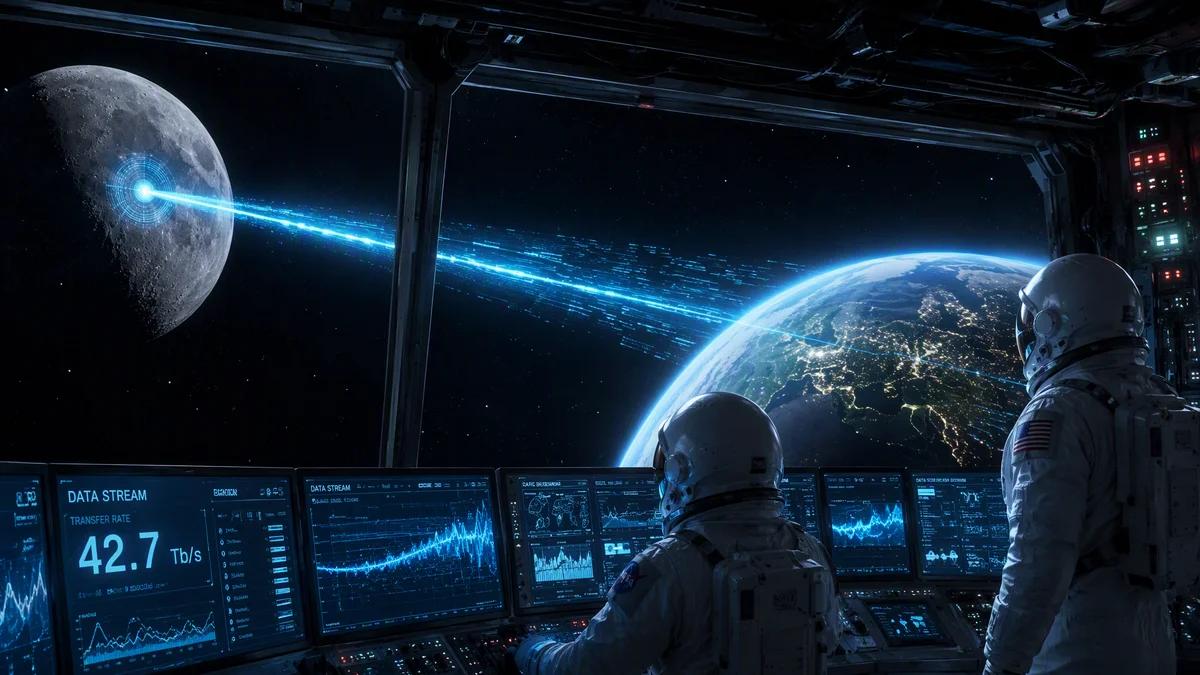
Somewhere over your head right now, a laser beam crossed 250,000 miles of space carrying more bandwidth than most home internet connections. NASA’s Orion Artemis II Optical Communications System, working with AWS ground infrastructure, has beamed the first-ever 4K livestream from the Moon at 260 megabits per second, roughly fifteen times what a typical streaming service needs. It was a demonstration. It was also a declaration about how the next era of lunar missions will talk to Earth.
Key Takeaways
- The first lunar 4K livestream hit 260Mbps via laser optical communications.
- The signal traveled over 250,000 miles, received at Mount Stromlo Observatory in Australia.
- Laser links offer far higher bandwidth than the radio systems used since Apollo.
- The system carries mission-critical data, telemetry and voice, not just showpiece video.
Why laser beats radio
Every deep space mission you have ever watched came home over radio, and radio is hitting its limits. The physics is unforgiving: radio waves spread as they travel, so a signal from the Moon arrives spread across an enormous area, and only a sliver reaches the receiving dish. That is why deep space bandwidth has always been rationed, why historic footage arrives grainy and delayed, and why missions budget their data like water in a desert.
Laser communications attack the problem at the source. A tightly focused optical beam spreads far less over the same distance, concentrating the signal and multiplying usable bandwidth by an order of magnitude or more. The 260Mbps lunar stream is the proof: data rates that radio physically cannot deliver from that distance, arriving through a terminal at Mount Stromlo Observatory in Australia and routed through NASA’s White Sands Complex to screens worldwide.
What 260Mbps actually buys a mission
The showpiece number is the 4K video, and it matters for public engagement in ways Apollo understood instinctively: humans follow missions they can see. But the operational payload is bigger than the spectacle. The same link carries high-rate telemetry, real-time voice, science instrument data and the thousands of health measurements a crewed spacecraft generates every second. Artemis II is a crewed flight around the Moon, and a crewed mission that can see, hear and diagnose in real time is categorically safer than one phoning home through a straw.
The ground game nobody sees
The unsung half of this achievement is terrestrial. Optical links need clear-sky ground stations, precision pointing measured in fractions of a degree, and cloud-resilient networking to route data once it lands, which is where the AWS partnership comes in. Building a receiving network for laser comms is its own infrastructure program, and the Mount Stromlo to White Sands pipeline demonstrated here is the template for a permanent lunar communications backbone, the kind of infrastructure we also see racing ahead in our coverage of the new generation of deep space missions.
The engineering behind the beam
Hitting a receiver from a quarter million miles away with a laser is a pointing problem that makes radio look forgiving. The optical terminal has to acquire the ground station, lock on, and hold that lock while both ends move: the spacecraft in flight, the Earth rotating underneath the receiver, everything vibrating. The tolerances involved are measured in microradians, the angular equivalent of hitting a coin from kilometers away, held continuously for the duration of a stream.
The payload that does this is deliberately compact, because optical terminals are also a mass and power bargain compared to equivalent radio systems. That matters on a crewed capsule where every kilogram is budgeted a hundred times over. Better bandwidth with less hardware is the kind of engineering trade that propagates into everything else the spacecraft can carry.
What comes after the Moon
The deeper implication is Mars. Every optical link proven at lunar distance is a stepping stone to the communications architecture a crewed Mars mission demands, where radio delays stretch to twenty-two minutes and bandwidth becomes the difference between a crew that is supported and a crew that is alone. NASA’s laser demonstrations are sequenced deliberately: prove it near Earth, harden it at the Moon, depend on it at Mars.
The road to boots on the Moon
The timing is the point. Artemis II is the crewed rehearsal for the landing missions that follow, and every system on it is being validated for the flights that will actually return humans to the surface. Communications is not a luxury in that chain; it is load-bearing. A permanent lunar presence, the kind both NASA and its international competitors are now openly planning, needs bandwidth for science, operations, safety and the simple morale of a crew that can call home in high definition.
There is a pleasing symmetry to it. The first Moon landing was watched in flickering black and white on a signal so marginal that engineers fought for every frame. The next one will stream in 4K by laser, live, to twenty-five million screens. The sixty years between those two pictures is the entire story of space communications, and the next chapter just got written in light.
The commercial angle deserves a mention too, because the AWS involvement is not incidental. Cloud infrastructure handling deep-space data is part of a larger shift where the ground segment of spaceflight, the unglamorous half of every mission, moves onto commercial networks built for planetary-scale routing. When the data firehose from a lunar mission lands, it needs to be processed, distributed and archived at rates that old mission-specific ground systems were never designed for. The cloud was built for exactly this, and space is adopting it fast.
Mission details and the optical communications program are documented on NASA’s official site.
The bottom line
A 260Mbps laser link from the Moon is not a stunt; it is the communications backbone of the next decade of lunar exploration, proven end to end on a crewed mission timeline. The grainy Apollo footage was the best radio could do. The next footprints on the Moon will arrive in 4K, live, by laser. Deep space just got broadband.
Will you watch the next Moon landing live? Tell the science desk.

Alex Mercer is the managing editor of Tech News Xplore. A hardware journalist for over a decade, he has benchmarked more CPUs, GPUs and handhelds than he can count, and leads the publication's testing methodology and editorial standards.