Xbox struggles to move physical discs, accounts for only 4% of disc sales in the US this year
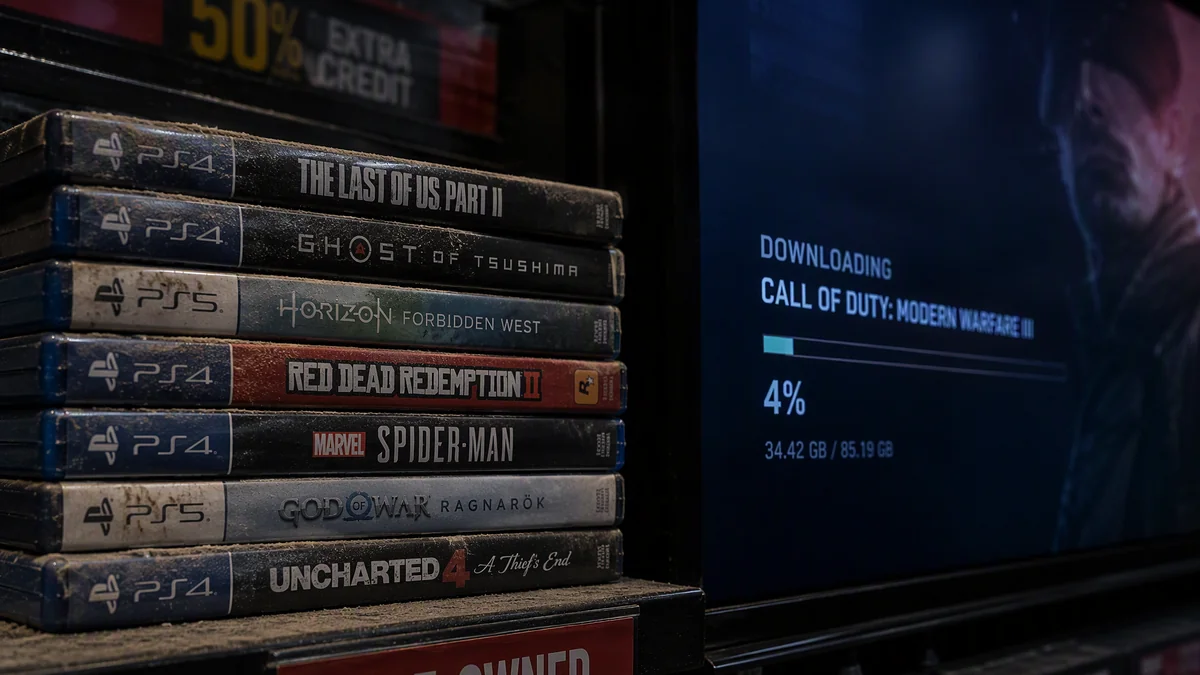
Walk into any game store in America and the shelves tell a story before you read a single number. This year, the numbers arrived to confirm it: Xbox accounted for roughly 4% of physical disc sales in the US, a figure so low it stops being a market share statistic and starts being an obituary for the Xbox disc.
Key Takeaways
- Xbox represents only about 4% of US physical disc sales this year, per market reports.
- Nintendo and PlayStation buyers still purchase physical media at dramatically higher rates.
- Game Pass and an all-digital console strategy have trained the Xbox audience to skip discs entirely.
- The figure raises real questions about the future of Xbox physical releases at retail.
What the number actually means
Four percent is not “Xbox games sell poorly”, full stop. It is the intersection of two curves: overall physical sales keep shrinking across the industry, and within that shrinking slice, Xbox owners have essentially stopped showing up. Nintendo players still buy cartridges in serious volumes, driven by gifting, collecting and a first-party catalog that holds value for years. PlayStation occupies the middle, its blockbuster exclusives still moving discs. Xbox, meanwhile, built a digital-first ecosystem and its audience followed.
The comparison that matters is generational. A decade ago, platform splits in physical sales tracked install bases reasonably closely. Today’s gap is behavioral, not just numerical.
How Microsoft engineered this outcome
None of this is an accident, and very little of it should surprise Redmond. Game Pass is the gravitational center of the Xbox strategy: a subscription that makes the concept of buying a game, let alone owning its disc, feel almost antique to its heaviest users. Add the all-digital Series S as the entry point for a generation of players, aggressive digital storefront sales, and day-one subscription launches for first-party titles, and you have a platform that has systematically trained its customers to never visit a physical shelf.
The strategy has clear logic. Digital margins are better, distribution is instant, and the subscription relationship is stickier than any disc sale. But the 4% figure exposes the cost: retail presence matters for visibility, and a platform invisible on shelves cedes that ground to competitors.
The collector and preservation problem
Physical media’s loudest defenders are not luddites; they are collectors and preservationists making a structural argument. A disc is a license you hold; a download is a license you rent under terms that can change. When a digital storefront delists a title or a platform holder shutters a store, physical copies become the only legitimate path to play. An ecosystem at 4% physical is an ecosystem one policy decision away from serious preservation gaps.
The Game Pass effect on game value perception
There is a subtler consequence buried in the 4% figure: what a subscription does to the perceived value of a single game. When hundreds of titles stream for one monthly fee, the individual $70 purchase starts to feel irrational to the subscriber, and the physical copy, the one thing you can resell or lend, becomes the strangest purchase of all. Xbox owners did not just go digital; many of them have quietly stopped buying games as discrete objects at all. That behavioral shift, once complete, does not reverse. Even a hypothetical future where Microsoft championed physical media again would be selling to an audience that no longer thinks in shelves.
Retail’s quiet retreat
Retailers read these numbers too. Shelf space is allocated by sell-through, and a platform moving 4% of discs gets 4% of the shelf, then less, in a feedback loop that is already visible in major US chains. Several publishers have quietly shipped “code in a box” physical releases on Xbox, a product that preserves the ritual of a store purchase while containing no game data at all. It is the disc’s ghost, and its existence tells you where this ends.
The international picture
The 4% figure is American, and geography matters here. Physical media declines at different speeds in different markets: regions with slower broadband hold onto discs longer, markets with strong second-hand retail cultures keep physical alive, and collector behavior in parts of Europe and Asia has proven more durable than in the US. Xbox’s physical collapse is furthest along in its strongest digital market, which is exactly what a strategy-driven decline looks like: where the subscription and digital infrastructure are best, the disc dies first.
What publishers do with data like this
Platform-level numbers reshape decisions most players never see. A publisher deciding whether to fund a physical run for a mid-tier Xbox title now has a data point saying the retail audience may simply not exist. Expect more digital-only releases, more limited collector runs produced for enthusiasts rather than shelves, and more “code in a box” compromises. The 4% is not just a measurement of the present; it is an argument publishers will use to build the future, one print run at a time.
Does it actually matter for players
For most Xbox owners, honestly, no. Game Pass plus digital convenience is a genuinely good deal, and the audience has voted with its downloads. The people it matters for are the ones at the margins: rural players on capped connections, collectors, gift buyers, and anyone who resells games to fund the next one. For them, each percentage point of decline makes the ecosystem slightly worse.
The broader industry context is that physical is becoming a premium, enthusiast product across gaming, closer to vinyl than to extinction. Limited runs, collector’s editions and boutique publishers are thriving even as mass-market discs fade. Our coverage of the hardware side of gaming, like the ROG Ally X, shows the same pattern: the future is digital distribution, and the physical remnant survives by being special.
The market data behind figures like this is tracked by Circana, the US retail research firm.
The bottom line
Four percent is the sound of a strategy completing itself. Microsoft built a digital empire on Game Pass, and its players moved in and redecorated. The Xbox disc is not dead yet, but it is now a niche product on a platform that no longer needs it. The only real question left is whether the last disc tray on an Xbox console survives the next hardware generation. After this year’s numbers, would you bet on it?
Still buying physical? Tell the gaming desk why and we will feature the best arguments.

Alex Mercer is the managing editor of Tech News Xplore. A hardware journalist for over a decade, he has benchmarked more CPUs, GPUs and handhelds than he can count, and leads the publication's testing methodology and editorial standards.
1 reader comment