PlayStation 6 handheld not expected to stay under $600, warns leaker
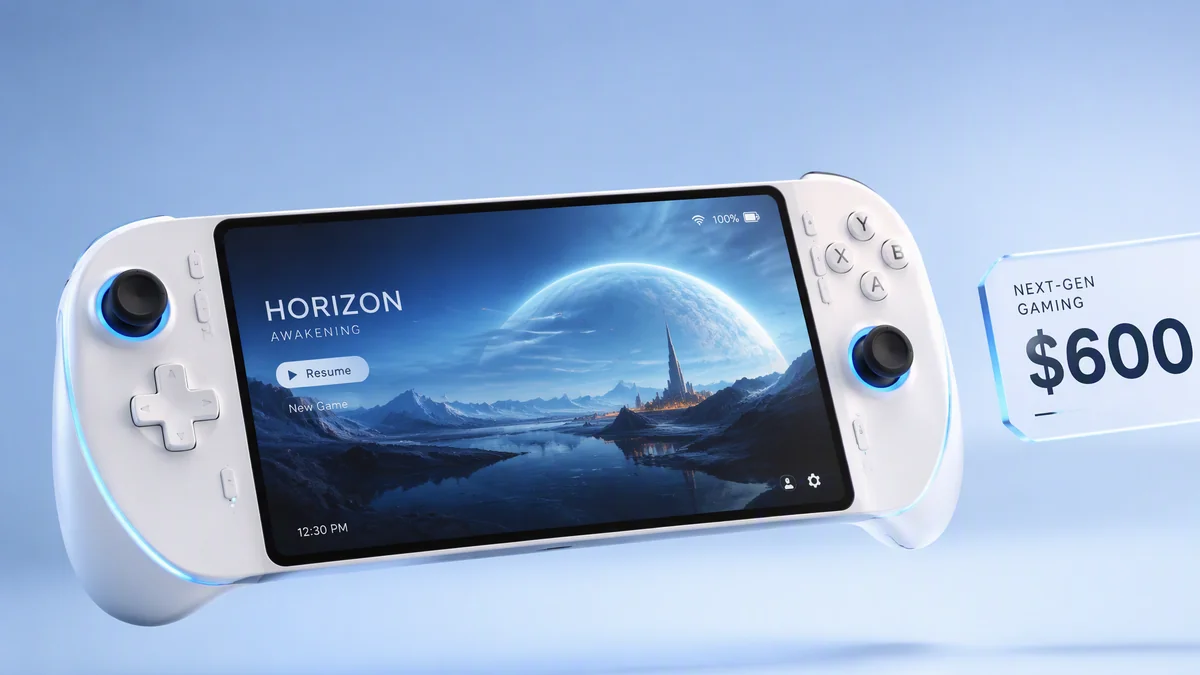
Hope you enjoyed the era of the $400 handheld, because it may be ending. A prominent hardware leaker is warning that Sony’s rumored PlayStation 6 handheld will not come in under $600, and the reason has nothing to do with Sony’s margins and everything to do with a memory market being eaten alive by AI data centers.
Key Takeaways
- A leaker with a solid track record says the PS6 handheld will not stay under $600.
- DRAM and NAND manufacturing costs are being driven up by enterprise AI demand.
- Next-generation handhelds need large, fast memory pools, making them unusually exposed to this inflation.
- The warning echoes pricing pressure already visible across the handheld market.
The leak and the leaker
First, the sourcing hygiene: this is a leak, not an announcement. Sony has not confirmed the handheld exists, let alone priced it. The claim comes from a hardware leaker whose previous component-level predictions have aged reasonably well, which earns the report attention but not certainty. Everything that follows should be read as informed projection, not fact.
With that said, the core claim is plausible enough to take seriously: the PlayStation 6 family reportedly includes a handheld companion device with genuinely current-generation internals, and the bill of materials for such a machine is moving in the wrong direction.
The memory market is the villain
Here is the mechanism, and it is not exotic. AI data centers are consuming high-bandwidth, high-capacity memory at a scale that is reshaping fabrication priorities across the industry. When the enterprise market pays premium prices for every wafer a fab can produce, consumer memory stops being the priority customer. Contract prices for DRAM and NAND have climbed accordingly, and every device maker downstream, from phone makers to console builders, pays the difference.
Handhelds are unusually exposed to this. A modern gaming handheld is essentially a memory subsystem with a screen attached: a large unified pool of fast LPDDR feeding both CPU and GPU, plus NVMe storage big enough for modern game installs. When memory prices spike, the handheld’s bill of materials absorbs the hit on two fronts at once.
What the handheld is rumored to be
Stitching together the credible reporting to date: the PS6 handheld is described as a native-play device rather than a streaming accessory, with AMD silicon derived from the same architecture generation as the home console, full backward compatibility ambitions and a dock-friendly design. That profile matters for the price discussion, because native play demands the memory and thermal budget of a small console rather than the thin client economics of a streaming screen. Every rumor in that direction supports the leaker’s core warning: this device cannot be built cheaply, and pretending otherwise helps no one.
The precedent is already here
You do not have to wait for Sony to see the pressure. Premium handhelds have been creeping up in price for two product cycles, and the components excuse is real: compare what $549 bought at the start of the handheld revival versus what it buys now. Our ROG Ally X review noted exactly this shift, where a bigger battery and more RAM pushed the device into territory that would have been unthinkable pricing a few years earlier, and buyers largely accepted it because the hardware justified the number.
What $600-plus buys in a handheld
If the leak is accurate, Sony faces a positioning puzzle. At $400, a handheld is an impulse-adjacent purchase sitting under the home console. At $600 or beyond, it is a premium device competing with laptops and the console itself, and it must justify that with native-level performance rather than streaming compromise. That likely means a custom AMD APU, a fast memory pool (expensive, see above), a high quality display and a real battery, which is precisely the configuration that cannot be built cheaply right now.
The optimistic reading: a $600-plus handheld that genuinely runs PS6-generation games would still undercut the total cost of equivalent PC handheld setups while offering the simplicity console buyers actually want.
How Sony could still hit a lower price
Before accepting $600-plus as destiny, consider the levers console makers actually pull. Sony subsidizes hardware against software attach: a handheld that locks buyers into the PlayStation ecosystem earns back hardware margin through game sales and subscriptions. It can ship multiple storage tiers, using NAND capacity as the price ladder. It can time the launch to the memory cycle, or lock component contracts years early, which is precisely what sophisticated buyers do when they see a supercycle coming. The leaker’s warning describes component reality; Sony’s pricing decision will describe strategy, and those are different things.
The handheld market context
The competition has already repriced the category. Premium Windows handhelds have normalized $650 to $800, and buyers have paid it when the hardware justified the number, as we found in our Ally X review. A PlayStation handheld at $600 would land below the premium PC tier while offering something those devices cannot: native access to a console ecosystem. That comparison, not the ghost of the $249 Vita, is the frame Sony’s marketers would actually use.
The timing question
Memory cycles are exactly that: cycles. The AI-driven supercycle will eventually meet new fab capacity, and prices will soften, but the industry’s own capacity roadmaps suggest that relief is measured in years, not quarters. If the PS6 handheld targets a launch window within that period, Sony either eats margin, charges the price, or ships a weaker machine. The leak suggests the company is not planning to ship a weaker machine.
Nothing is official until it appears on Sony’s official PlayStation site.
The bottom line
Treat the $600 figure as a warning flare rather than a price tag: nothing is confirmed, and leakers are wrong often enough to keep salt nearby. But the underlying pressure is documented and real. AI’s appetite for memory is quietly repricing every device you own, and the next generation of handhelds is first in line. If Sony’s portable future costs $600, blame the data centers, not just the accountants.
Would you pay $600 for a true PlayStation handheld? Cast your vote with the gaming desk.

Alex Mercer is the managing editor of Tech News Xplore. A hardware journalist for over a decade, he has benchmarked more CPUs, GPUs and handhelds than he can count, and leads the publication's testing methodology and editorial standards.
2 reader comments