AMD confirms the Radeon RX 9050 4GB will have a tiny 64-bit bus and just 16MB Infinity Cache
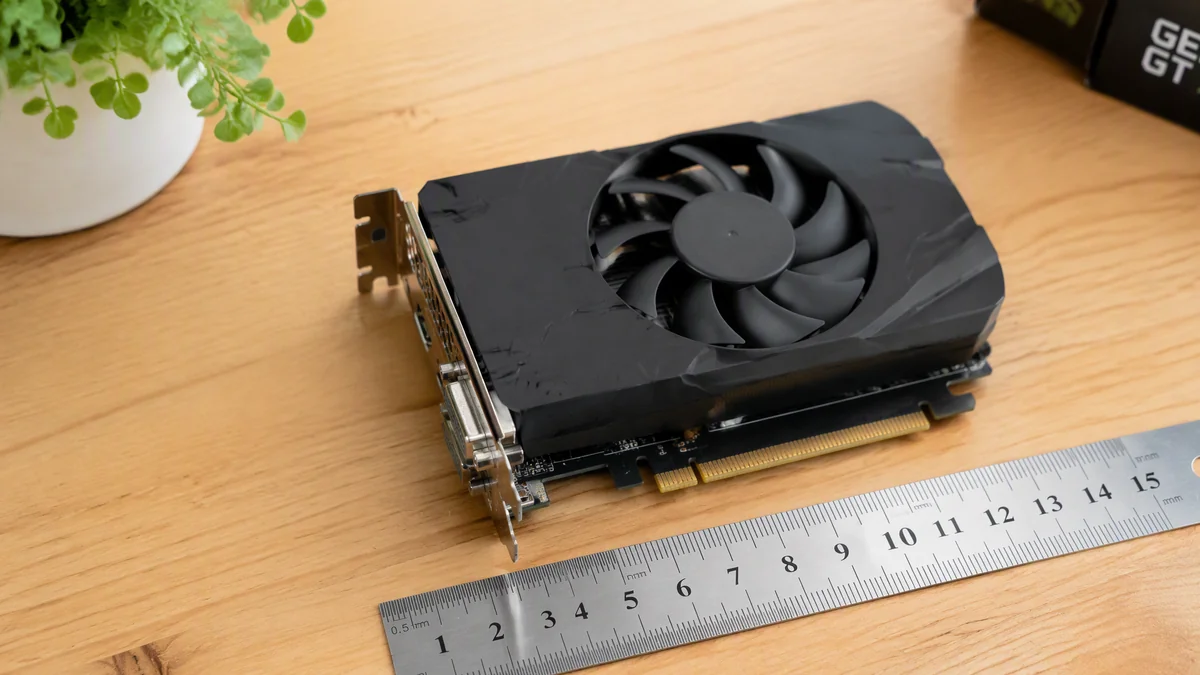
There is budget, and then there is whatever this is. AMD has confirmed the Radeon RX 9050’s specifications, and they read like a card designed by the cost department: 4GB of memory, a 64-bit bus, and just 16MB of Infinity Cache. In 2026, those numbers are not a specification. They are a statement about who entry-level buyers are supposed to be.
Key Takeaways
- The RX 9050 is confirmed with 4GB VRAM, a 64-bit memory bus and 16MB of Infinity Cache.
- Memory bandwidth will be the card’s defining limitation, more than raw compute.
- It targets esports titles, older games and basic display output rather than modern AAA.
- The spec sheet raises fair questions about how low the entry level can reasonably go.
Decoding the spec sheet
Three numbers define this card. Four gigabytes of VRAM is the floor of viability in 2026: enough for esports titles at modest settings, immediately insufficient for modern AAA releases with current texture budgets, which have been punishing 8GB cards for two years. The 64-bit bus is the bandwidth chokepoint: even with fast GDDR6, 64 bits delivers a fraction of the throughput mainstream cards enjoy. And 16MB of Infinity Cache, AMD’s on-die bandwidth rescue technology, is a quarter of what midrange RDNA cards carry, which limits how much the cache can compensate for the narrow bus.
Put plainly: every safety net this architecture family normally provides has been trimmed on this model.
Who this card is actually for
To be fair to the product before judging the positioning: there is a real market here. Esports titles, the games that actually dominate global play hours, run fine on modest hardware. Office machines, home theater PCs, budget esports boxes and emerging-market builds need a modern, efficient, cheap GPU with current display outputs and driver support. A card like this, priced correctly, serves all of them.
The problem is never the existence of an entry-level product. It is the marketing gravity that pulls budget buyers toward settings and games the hardware cannot sustain, and the review-cycle habit of judging such cards against games they were never meant to run.
Where it fits in AMD’s lineup
The RX 9050’s role is clearest when you map the stack around it. Above it, AMD fields the genuinely capable mainstream and high-end parts that trade blows with the competition at 1440p and beyond. The 9050 exists at the opposite pole: the volume product for system integrators, office fleets and first-build budgets, where its buyer will never open a spec comparison and never run a game that stresses it. That dual-track reality, halo products for enthusiasts, utility products for volume, is how every GPU vendor actually makes money. The error would be reviewing this card as if it belonged to the first track.
The 4GB debate, again
The industry has had this argument repeatedly, and the answer keeps getting clearer: VRAM capacity ages a card faster than any other specification. A GPU with compute to spare dies early when its memory fills; we watched 8GB mainstream cards hit texture walls in recent releases, and 4GB starts far closer to the cliff. Buyers considering this card for anything beyond esports should plan their expectations, and their settings, accordingly.
Reading the bandwidth math
Memory bandwidth is bus width multiplied by memory speed, and the arithmetic here is stark. A 64-bit bus paired with fast GDDR6 delivers roughly a quarter of the bandwidth of a 256-bit mainstream card. Infinity Cache exists to absorb exactly this gap by keeping hot data on-die, which is why the cache cut to 16MB stings: less cache means more trips across the narrow bus, and more trips mean the bottleneck compounds. The result is a card whose real-world ceiling is set by its plumbing long before its compute units break a sweat.
What reviewers will need to test
When this card lands on test benches, the numbers that matter will not be the headline averages. Frame-time consistency at 1080p in modern, texture-hungry games is where 4GB either survives or collapses, and the difference between those outcomes is often driver-managed memory allocation rather than raw hardware. Upscaling quality at this tier deserves scrutiny too: entry cards lean hardest on upscalers, and artifacts that are forgivable at 1440p become glaring when the base render resolution drops this low.
The other test is longevity, and it cannot be run in a week. The right question for a card like this is not “how does it run today’s games” but “how will it run the games of two years from now”, and history’s answer for narrow-bus, small-buffer cards has been consistent: badly. Buyers should plan their expectations around a short, honest service life rather than a long one.
The efficiency silver lining
One genuinely good trait comes with this territory: tiny GPUs sip power. A card in this class typically needs no exotic power connectors, fits any case, runs cool and quiet, and slots into prebuilt office machines without touching the PSU. For the buyers this card actually targets, those are features, and they are the reason cards like this exist in every generation despite the spec-sheet mockery they reliably attract.
The competitive angle
AMD is not alone in this territory; both vendors maintain entry lines that exist largely to hit price points and power display outputs. The broader context is a GPU market where the interesting action sits higher up the stack, as our ROG Strix RTX 5070 Ti review showed: 16GB, wide buses and generous caches are where modern gaming actually lives. The RX 9050 exists to be the card you buy when that world is out of reach, and it will sell in volume for exactly that reason.
When published, official specifications will live on AMD’s product pages.
The bottom line
The RX 9050 is not a bad product; it is an honest set of compromises that must be priced like one. At a genuinely low price, a 4GB, 64-bit card with modern efficiency serves esports rigs and utility builds perfectly well. But the specification is a warning label as much as a feature list: buy it for what it is, and it will serve you. Buy it expecting more, and 4GB will teach you otherwise by year’s end.
Building an ultra-budget rig? Ask the hardware desk whether this class of card fits your games.

Alex Mercer is the managing editor of Tech News Xplore. A hardware journalist for over a decade, he has benchmarked more CPUs, GPUs and handhelds than he can count, and leads the publication's testing methodology and editorial standards.