Thermal Grizzly is now selling a pre-delidded AMD Ryzen 9 9950X3D2 with warranty
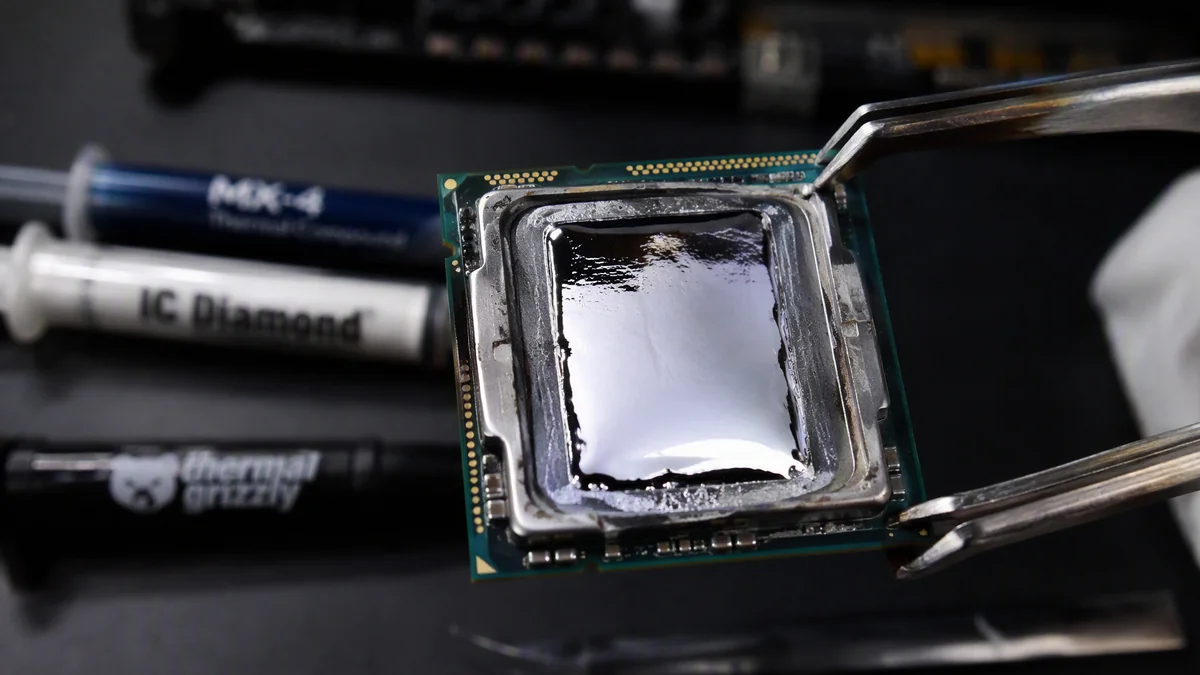
Delidding has always been the enthusiast’s forbidden ritual: slice off the CPU’s heat spreader, gain double-digit temperature drops, and kiss your warranty goodbye forever. Thermal Grizzly just broke the spell. The company is now selling a pre-delidded Ryzen 9 9950X3D2 with its own replacement warranty, which changes the entire risk equation of direct-die cooling.
Key Takeaways
- Thermal Grizzly sells the Ryzen 9 9950X3D2 already delidded, with the heat spreader professionally removed.
- The package includes a replacement warranty from Thermal Grizzly covering the modification.
- Direct-die cooling typically delivers significant temperature reductions on high-power CPUs.
- The 9950X3D2 combines 16 cores with 3D V-Cache on both CCDs, making it the ultimate thermal challenge.
What delidding is and why people risk it
Modern CPUs ship under an integrated heat spreader, a metal lid that protects the silicon but adds a thermal barrier between the die and your cooler. Delidding removes that lid so the cooler’s cold plate contacts the die almost directly, usually via liquid metal. The temperature improvements are real and often dramatic on hot-running parts: double-digit Celsius drops under sustained load, which translate directly into sustained boost clocks and quieter fans.
The catch has never been technical. It is existential. One slip of the delidding tool kills a flagship chip, and even a perfect job voids the manufacturer warranty, leaving you with an expensive, fragile, unprotected processor.
The 9950X3D2 is the perfect candidate
If any chip justifies this treatment, it is this one. Sixteen cores plus 3D V-Cache on both compute dies makes for extraordinary performance density and extraordinary thermal complexity: cache-stacked silicon is famously temperature-sensitive, which is why X3D chips historically ran conservative clocks. Our 9850X3D review covered how the second-generation cache layout improved that picture; the 9950X3D2 pushes the concept to its dual-stacked extreme, and every degree of cooling headroom you buy back translates into performance.
Why manufacturers will not do this themselves
A reasonable question follows: if delidding is this beneficial, why does AMD not sell a factory direct-die edition? Liability and logistics. The heat spreader exists partly to protect silicon through millions of installs by users of wildly varying competence; removing it at the factory means accepting breakage rates and support complexity that a mass-market vendor cannot absorb. That is precisely the gap a specialist like Thermal Grizzly can fill: small volumes, expert handling, and a customer base that reads instructions. It is the same boutique logic we see across the enthusiast market, where smaller brands take the risks the giants cannot, not unlike what we noted when covering the boutique keyboard surge.
The warranty is the actual product
Let us be precise about what Thermal Grizzly is selling, because the delidding itself is a service any careful enthusiast can perform. The product is the transferred risk: if the modified chip fails under the covered conditions, Thermal Grizzly replaces it. That transforms delidding from a gamble into a purchasing decision, and it is why this offering matters beyond its niche. It is effectively a new product category: manufacturer-adjacent, warranty-backed extreme cooling modification.
What arrives in the box and how it works
The pre-delidded package is a finished system, not a bag of parts: the chip with its heat spreader professionally removed, surfaces prepared for direct-die contact, and guidance for compatible mounting hardware. Installation uses a direct-die frame, which replaces the motherboard’s standard retention mechanism to apply correct, even pressure on the exposed silicon. Liquid metal or an equivalent high-performance interface material bridges the microscopic gap to the cold plate. Done properly, the whole assembly is no more exotic than a custom water loop, and considerably cheaper.
The safety checklist that still applies
Warranty-backed does not mean carefree. Liquid metal is electrically conductive and demands disciplined application; socket contact frames require correct torque; and X3D chips enforce their own voltage guardrails that builders must respect regardless of cooling. The warranty covers the modification itself, not every possible mistake made around it. Read the documentation twice, assemble once, and this is a safe product. Improvise, and no warranty on earth saves a shorted socket.
The temperatures behind the pitch
What does delidding actually buy on a chip like this? Community data on direct-die X3D builds consistently points to double-digit temperature reductions under sustained all-core load, the kind of headroom that converts directly into higher sustained boost clocks and quieter cooling. On a dual-cache-stacked flagship, where heat has to travel through more silicon before it escapes, the improvement sits at the generous end of that range. For workstations rendering or compiling for hours, that is not a marginal gain; it is the difference between a chip that holds its boost and one that politely gives it back.
There is a second, quieter benefit: thermal cycling. Lower peak temperatures and smaller temperature swings reduce long-term stress on the package, the solder and the cache stack itself. Nobody can promise longevity data for a brand-new product category, but the physics of cooler silicon aging better is not controversial.
Who should buy it, and who should not
The honest buyer profile: someone building a no-compromise workstation or gaming flagship, running sustained all-core loads or chasing every last frame, with the cooling hardware (direct-die frame, liquid metal, serious cooler) to exploit the modification. If you are pairing it with an overbuilt board and a top-tier cooler, like the class of hardware in our X870E coverage, the package makes sense.
The honest skip profile: anyone whose loads are bursty gaming on a midrange cooler, where the stock chip already boosts to its limits. Delidding headroom you never touch is money spent on a spec sheet.
Ordering and compatibility details are on Thermal Grizzly’s official shop.
The bottom line
Thermal Grizzly has done something the industry has danced around for a decade: made the most effective CPU cooling modification a safe, warrantied, purchasable product. The pre-delidded 9950X3D2 is expensive, niche and entirely serious, just like the ritual it replaces. Forbidden no more; now it is simply a line item.
Would you run a direct-die flagship? Tell the hardware desk how far you would go for ten degrees.

Alex Mercer is the managing editor of Tech News Xplore. A hardware journalist for over a decade, he has benchmarked more CPUs, GPUs and handhelds than he can count, and leads the publication's testing methodology and editorial standards.