Seasonic’s new 1600W PSU is the first ATX power supply with 80 PLUS Ruby certification
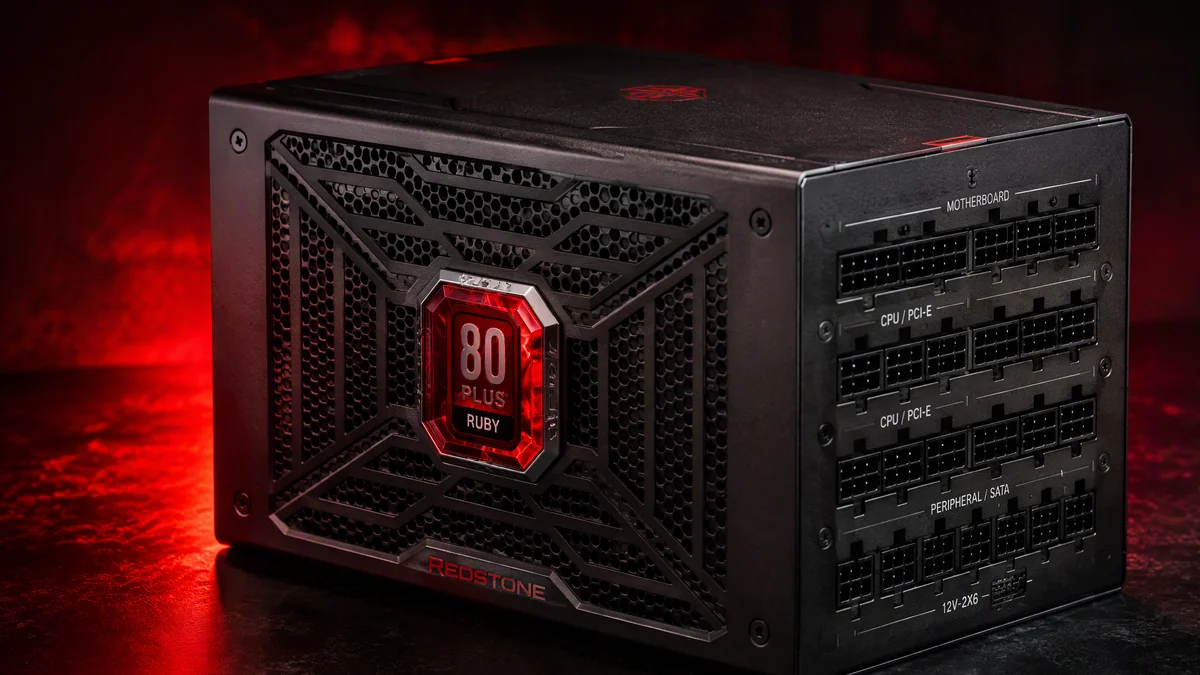
Power supplies are the least glamorous component in your PC and the one that decides whether everything else survives. Seasonic just gave the category a genuine first: a 1600W flagship that is the first ATX power supply certified 80 PLUS Ruby, the new efficiency tier above Titanium. In an era of 300-watt CPUs and power-hungry flagships, the timing is not subtle.
Key Takeaways
- Seasonic’s 1600W unit is the first ATX PSU with 80 PLUS Ruby certification.
- Ruby sits above Titanium, demanding higher efficiency across a wider load range.
- 1600W targets extreme builds: flagship GPU plus high-core-count CPU with transient headroom to spare.
- The certification signals where premium PSU design is heading as system power keeps climbing.
What 80 PLUS Ruby actually requires
The 80 PLUS ladder has existed for two decades, and each new rung gets harder because the easy efficiency gains are long claimed. Ruby, introduced as the tier beyond Titanium, tightens requirements at the load points that matter most in real systems: not just the flattering 50% load measurement, but efficiency at low loads and full output, plus stricter power factor behavior. A PSU passing Ruby is converting wall power to component power with so little waste that heat output, the PSU’s own cooling burden, shrinks meaningfully.
That last point is the one buyers feel. Less waste heat means the PSU’s fan works less, and a PSU fan you never hear is one of the quiet luxuries of a premium build.
Why 1600W is no longer absurd
Do the math on a no-limits 2026 build. A flagship GPU can pull 450W or more under load with transients spiking far beyond. A 28-core class desktop CPU, like the 296W part in our Nova Lake leak coverage, adds another three hundred under all-core workloads. Storage arrays, memory, pumps and fans pile on. Suddenly 1600W is not excess; it is engineering headroom, the margin that lets a PSU run in its efficiency sweet spot rather than redlining when both flagship components boost simultaneously.
Transient response is the silent killer here: modern GPUs hit the PSU with microsecond power excursions that trip lesser units into protection shutdowns. A flagship Ruby unit is built precisely to shrug those off.
Why the first Ruby unit comes from Seasonic
There is a pattern in PSU history: new efficiency tiers are first claimed by the same small group of engineering-led manufacturers, and Seasonic is perennially among them. Being first to a certification is partly a technical achievement and partly a statement of intent, a way of telling the market where your R&D budget lives. For the rest of the industry, a first Ruby ATX unit sets a reference point every rival flagship will now be measured against, the same way early Titanium units once redefined what premium meant. Expect competitors to answer within a product cycle or two; that is how certification races have always gone.
The build-quality question
Seasonic’s reputation was earned on platforms that became the reference designs for much of the industry, so expectations here are appropriately high: top-tier capacitors, fully modular cabling, current ATX 3.x and PCIe connector standards with proper 12V-2×6 support for modern flagship cards, and a warranty measured in decades rather than years. We will verify ripple, hold-up time and transient behavior on the bench per our testing methodology if a sample arrives.
The efficiency math that quietly pays
Efficiency tiers sound abstract until you price them. The gap between a good Gold unit and a Ruby unit at high sustained load translates to dozens of watts not converted to heat, which over years of heavy use shows up in electricity bills, case temperatures and fan noise across the entire system, since every watt the PSU wastes is a watt your case cooling must exhaust. For workstations that run loaded all day, the premium efficiency tier has a genuine payback argument rather than a purely emotional one.
Why 1600W is no longer absurd
A decade ago, a 1600W power supply was a novelty for multi-GPU benchmark rigs. Today the math has quietly changed. A modern flagship GPU can spike transient loads that would have embarrassed entire systems a generation back, and pairing one with a high-core-count CPU, a fistful of NVMe drives and serious cooling pushes a well-built machine into territory where 1000W units run with little margin. Running a PSU at a comfortable fraction of its capacity is where efficiency, acoustics and longevity all peak, which makes an oversized, hyper-efficient unit a rational choice rather than an enthusiast affectation.
That said, honesty about the buyer profile matters, and we will get to it: most gaming PCs need nothing close to this. The point is that the niche this unit serves is real, growing and underserved, not that everyone should buy one.
Cabling, standards and the practical bits
A 2026 flagship PSU is defined as much by its connectors as its capacity: native 12V-2×6 with proper transient tolerance for modern flagship GPUs, enough PCIe and CPU power leads to avoid daisy-chain improvisation, and modular cables that do not fight the builder. ATX 3.x compliance, with its brutal transient requirements, is the standard that separates units designed for how modern components actually behave from units designed for how they behaved five years ago.
Who needs this, honestly
Nobody with a mainstream build. A quality 850W unit, like we recommended in our 5070 Ti review, handles a high-end single-GPU system comfortably. This unit serves the extreme tier: dual-purpose workstations, overclocked flagships, multi-GPU compute rigs and builders who simply want their PSU loafing at 40% load for a decade of silent service. In that role, Ruby efficiency plus 1600W capacity is the new reference point.
Efficiency tiers are defined by the official 80 PLUS program, and the unit itself is listed on Seasonic’s official site.
The bottom line
First to Ruby is a genuine milestone, and 1600W is the right capacity to carry it: the extreme end of PC building finally has an efficiency flagship worthy of the components it feeds. Most builders should buy smaller. But if your parts list reads like a power company’s newsletter, Seasonic just built your supply.
How many watts does your dream build really need? Ask the hardware desk and we will do the math with you.

Alex Mercer is the managing editor of Tech News Xplore. A hardware journalist for over a decade, he has benchmarked more CPUs, GPUs and handhelds than he can count, and leads the publication's testing methodology and editorial standards.