Noctua has no plans to introduce RGB lighting or screens to its coolers
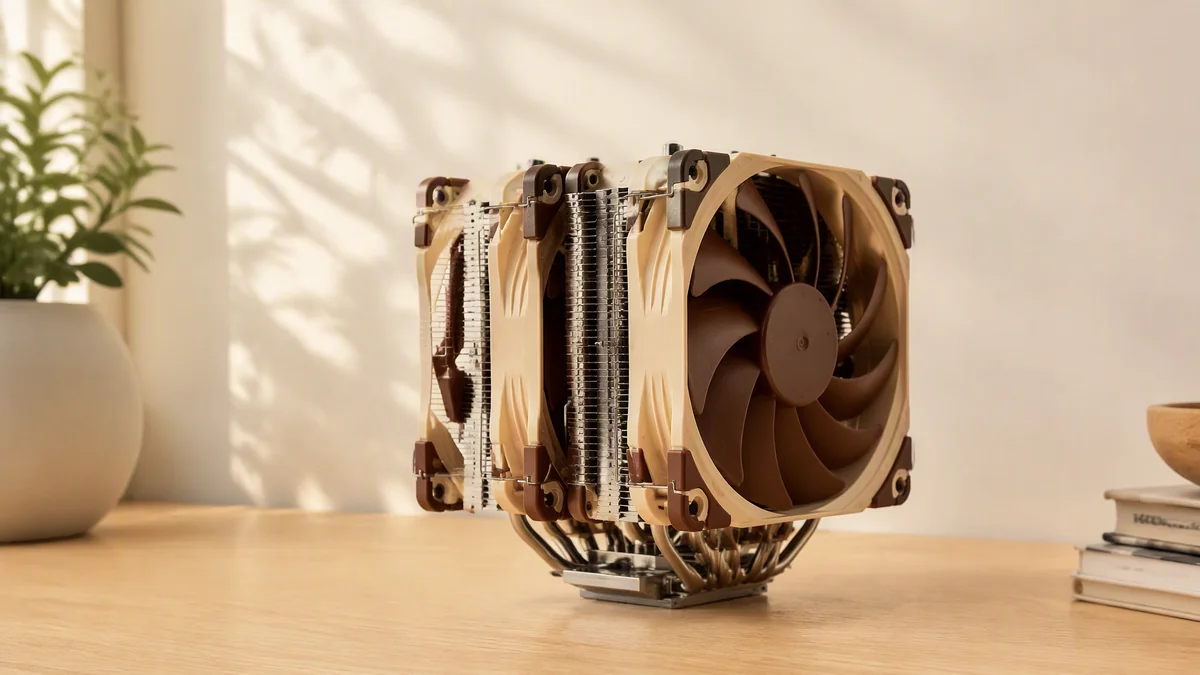
In a market where every CPU cooler now doubles as a disco light with a temperature readout, one company continues to ship beige and brown fans that glow with nothing but competence. Noctua has confirmed, again, that it has no plans to add RGB lighting or screens to its coolers. And honestly? The industry needs exactly one company that refuses.
Key Takeaways
- Noctua reaffirmed it will not add RGB lighting or LCD screens to its coolers.
- The company argues every design dollar goes to thermal performance, acoustics and longevity instead.
- The stance is contrarian marketing that doubles as genuine engineering philosophy.
- Buyers who want lighting have endless options; buyers who want silence have essentially one default answer.
The statement and the philosophy
Asked whether the company would follow competitors into illuminated, screen-topped coolers, Noctua’s answer was characteristically blunt: no plans. The reasoning is consistent with two decades of the same argument. A cooler has one job, moving heat quietly, and every gram of copper, every engineering hour and every dollar of bill of materials spent on lighting is not spent on fin density, heatpipe contact or bearing life.
This is not aesthetic stubbornness alone; it is a resource allocation doctrine. Noctua’s fans carry bearing warranties and acoustic specifications that most RGB-laden rivals do not attempt to match, precisely because the engineering budget went somewhere else.
The counterargument, taken seriously
Let us steelman the other side, because it is not stupid. Windowed cases are the norm, builds are display pieces, and a cooler with system stats on a small screen is genuinely useful for monitoring. RGB synchronization is the aesthetic language of an entire generation of builders. Companies that embraced it sell a lot of coolers, and several of them perform excellently while glowing. Performance and lighting are not mutually exclusive; they are just competing for the same budget.
There is also a real business risk in refusal. When every product photo in the market pulses with addressable LEDs, a brown fan looks like a relic to a first-time builder scrolling thumbnails. Noctua is betting that its reputation for silence outruns that first impression, and two decades of market results say the bet has worked so far.
The acoustics arms race Noctua is actually fighting
While rivals iterate on displays, Noctua’s actual roadmap reads like a different industry’s: new fan geometries refined over years, bearing and blade tolerances tightened generation over generation, and collaborations that bring its fan designs into entirely other product categories. The company’s famous slowness, flagship successors arriving after gaps that would sink a consumer brand, is the same discipline as the RGB refusal. Each product must justify its existence against measurement, not fashion. The result is a catalog where a cooler bought a decade ago remains a credible recommendation today, which in the PC industry is close to a miracle.
What Noctua offers instead
The company’s answer to aesthetics has been its chromax line: all-black versions of its signature coolers and fans, performance identical, lighting absent. It is a deliberately boring middle path, and it sells to exactly the buyer who wants a stealth build without the beige. The message is consistent: we will meet you on color, never on illumination.
The screen cooler trend, examined
It is worth being fair about what Noctua is refusing, because screen-topped coolers are not pure gimmick. A small display showing CPU temperature at a glance through the case window is legitimately useful, and several competing flagship coolers pair real thermal performance with exactly that feature. The trend’s weakness is execution drift: screens ship with buggy software, proprietary cables and companion apps that become abandonware. Buyers have learned to ask whether the display will still have driver support in five years. Noctua’s coolers, meanwhile, come with a mounting system that will outlive the socket it was bought for.
The community that keeps the pressure on
Noctua’s stance survives because its customer base actively rewards it. The enthusiast communities that evangelize the brand do so precisely because the products are boring in the best way: no software, no subscriptions, no features that rot. Every RGB lighting cycle that desyncs and every cooler screen that loses driver support is, quietly, an advertisement for the company that refused to ship either. The comment sections under this announcement read like shareholder letters, and in a sense they are: the brand’s refusal to chase trends is the asset its customers are protecting.
That dynamic also explains why rivals keep trying. Aesthetics genuinely sell components, and most buyers are not reading teardown reviews. The market is large enough for both philosophies, and arguably healthier with both in it. But only one of them gets to claim, ten years from now, that every product it ever shipped still works exactly as intended.
What would change Noctua’s mind
Never say never is not in this company’s vocabulary, but the honest version of its position is conditional: if lighting or displays could be added without compromising acoustics, thermals or longevity, the theological objection might soften. The company’s history suggests the conditions will never be met to its satisfaction, which is, when you think about it, exactly the point. The refusal is the product.
Why the stance matters beyond one brand
Markets need a control group. Noctua’s refusal provides the benchmark against which every lighting-laden cooler can be quietly measured: strip the RGB, price the difference, and ask what the glow actually cost in thermal performance. It is the same discipline we apply when reviewing premium cards, as in our Strix 5070 Ti review, where the question is always whether the premium bought engineering or decoration. One company’s stubbornness makes that question easier to answer for everyone.
The product roadmap behind this statement is published on Noctua’s official site.
The bottom line
Noctua will never ship an RGB cooler, and the PC world is better for it: someone has to keep proving that silence and thermals alone can carry a flagship product. If your dream build pulses like a nightclub, the market has you covered a hundred times over. If your dream build is the one you cannot hear, the beige and brown answer stands, unlit and unbeaten.
Team RGB or team silence? Settle it with the hardware desk.

Alex Mercer is the managing editor of Tech News Xplore. A hardware journalist for over a decade, he has benchmarked more CPUs, GPUs and handhelds than he can count, and leads the publication's testing methodology and editorial standards.