Apple iPhone Duo Is Official: Apple Finally Enters the Foldable Phone Race
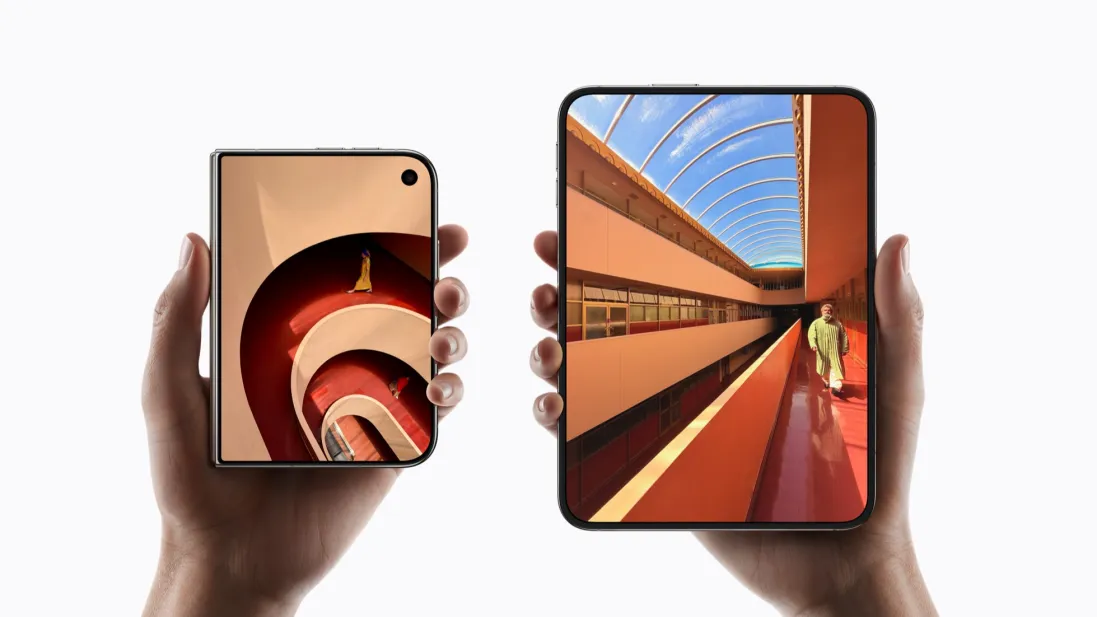
Apple has finally folded the iPhone literally. After years of rumors, patents and endless speculation, Apple has officially introduced the iPhone Duo, its first foldable smartphone and arguably the biggest physical redesign of the iPhone in years.
This isn’t simply an oversized iPhone that bends in the middle. Apple is pitching the Duo as a device that can behave like a normal compact phone when closed, then transform into something closer to a miniature tablet when opened.
The price makes its ambitions equally clear: $1,999 in the United States for the 256GB model. Pre-orders begin October 16, 2026, with general availability starting October 23.
Key Takeaways
- Apple’s first foldable smartphone is officially called the iPhone Duo.
- It combines a 5.4-inch outer screen with a 7.6-inch folding OLED display.
- The phone runs on Apple’s new A20 Pro chip and introduces foldable-specific features through iOS 27.
- Pricing starts at $1,999 for 256GB, with storage configurations reaching 2TB.
- Pre-orders open October 16, while sales begin October 23, 2026.
A 7.6-Inch iPhone That Still Fits in Your Pocket
The basic idea behind the iPhone Duo is straightforward.
Closed, you get a 5.4-inch Super Retina XDR outer display designed for normal one-handed smartphone use. Open the device and you’re looking at a 7.6-inch folding Super Retina XDR OLED panel, giving Apple the largest display it has ever shipped on an iPhone.
Both screens support ProMotion with adaptive refresh rates of up to 120Hz, Always-On functionality and peak outdoor brightness of up to 3,000 nits. Apple has also applied a nano-texture finish to the internal display in an effort to reduce glare and make the fold line less noticeable.
The hardware numbers are interesting too.
The Duo measures just 5.2mm thick when opened, although that increases to 11.3mm when folded. It weighs 254 grams and uses titanium in its construction.
More surprisingly, Apple lists an IP68 water and dust resistance rating. Durability has historically been one of the uncomfortable questions surrounding foldable devices, so that specification will attract plenty of attention once independent durability tests begin.
Apple is even bringing Apple Pencil support to the Duo later this year, using the USB-C version of its stylus.
A20 Pro Turns the Duo Into a Serious Gaming Machine on Paper
The Duo isn’t using a cut-down processor to compensate for its unusual chassis.
Inside is Apple’s A20 Pro, featuring a six-core CPU, seven-core GPU with hardware-accelerated ray tracing and dual 16-core Neural Engines. Apple says the chip is manufactured using a 2-nanometer process.
For gamers, that combination could make the Duo particularly interesting.
Open the phone and suddenly you’re playing on a 7.6-inch 120Hz OLED display with hardware ray tracing and considerably more screen space than a conventional iPhone. That’s a recipe that sounds excellent for demanding games, emulators, cloud gaming and controller-based setups.
There is an important catch: we don’t yet know how the Duo performs during extended real-world gaming sessions.
Apple has fitted a custom vapor chamber to manage heat, but benchmark scores and marketing claims won’t tell us how the device behaves after 30 or 60 minutes of sustained GPU load. That’s something independent testing will need to establish.
Apple claims up to 24 hours of typical use. Its specifications also list up to 31 hours of video playback using the inner display and up to 44 hours using the outer display. Real-world endurance with gaming, multitasking and 5G will almost certainly vary.
iOS 27 May Be More Important Than the Hinge
Foldable hardware is only half the battle.
We’ve seen technically impressive folding phones before. The difficult part is convincing people that unfolding their phone actually makes everyday tasks better rather than simply giving them a larger display.
Apple’s answer is a customized iOS 27 experience.
For the first time on an iPhone, Split View lets users run two apps side by side. Users can also open two windows from the same application, save app pairings and quickly move between applications on the larger display.
That could turn the Duo into a genuinely useful mobile workstation.
Imagine keeping Slack open beside Safari, watching a video while checking messages, comparing products across two browser windows or keeping a walkthrough open beside a game.
Apple says apps including Netflix, Zoom and Slack are already being adapted to take advantage of the folding interface. Developers are also getting APIs designed specifically around the new display configurations.
This software layer may ultimately decide whether the Duo feels revolutionary or merely expensive.
Readers following the wider evolution of smartphones, gaming hardware and consumer technology can find more coverage on TechNewsXplore.
Cameras, Touch ID and a Few Unexpected Decisions
Apple has equipped the Duo with a dual 48MP Fusion camera system, combining a 48MP main camera with a 48MP ultra-wide.
The main sensor can also provide an optical-quality 2x crop, although the Duo doesn’t offer the same dedicated camera flexibility you’d expect from Apple’s highest-end conventional Pro models.
The folding design creates some useful tricks.
Users can preview photos on the external display while shooting with the rear cameras, while Duo Preview lets the person being photographed see their framing in real time. Apple has also placed a FaceTime camera beneath the internal display.
Perhaps the biggest surprise is authentication.
Instead of relying on Face ID, the iPhone Duo uses Touch ID integrated into the side button. That makes practical sense for a device that can be held in several different configurations, but it also represents a major departure from Apple’s flagship iPhone formula.
What Apple Has Confirmed — and What Still Needs to Be Proven
The confirmed specifications make the iPhone Duo one of Apple’s most ambitious hardware launches in years.
The 7.6-inch display, A20 Pro processor, IP68 rating, Split View multitasking, Apple Pencil support, dual 48MP cameras and October release schedule are all official. The phone starts at $1,999 and will be offered with 256GB, 512GB, 1TB or 2TB of storage.
What isn’t confirmed is whether those ingredients will make foldable phones truly mainstream.
Long-term hinge durability remains to be tested. So does screen aging, crease visibility after months of use, real-world battery performance and the quality of third-party app optimization.
And then there’s the $1,999 question: does having an iPhone that unfolds into a small tablet justify paying roughly two thousand dollars before accessories or storage upgrades?
That’s where the iPhone Duo becomes more interesting than another annual smartphone update.
Apple isn’t merely competing on camera megapixels or processor benchmarks anymore. It’s asking users to rethink what an iPhone physically looks like and how it fits into their daily workflow.
Android manufacturers have spent years refining the foldable concept. Apple has arrived late, but it has arrived with the full weight of iOS, its developer ecosystem and millions of loyal iPhone customers behind it.
Now the real test begins.
Not whether Apple can build a foldable iPhone.
It has.
The question is whether the iPhone Duo can convince ordinary iPhone buyers that they actually need one.
Official Sources

Alex Mercer is the managing editor of Tech News Xplore. A hardware journalist for over a decade, he has benchmarked more CPUs, GPUs and handhelds than he can count, and leads the publication's testing methodology and editorial standards.